



Butter Substitute: What to Use for Baking, Cooking, and Spreading
If you’re standing in the kitchen mid-recipe realizing you’re out of butter, here’s the fast answer: the best butter substitute depends entirely on what you’re doing with it.
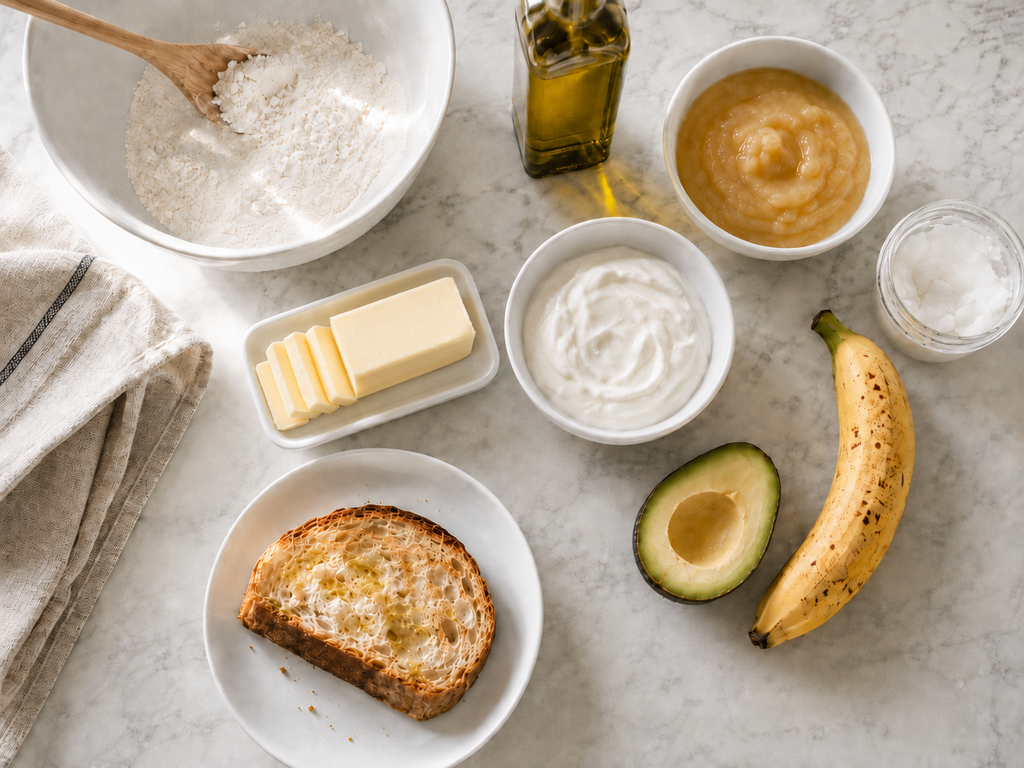
- For baking, reach for applesauce, mashed banana, Greek yogurt, or oil.
- For cooking, olive or avocado oil does the job.
- For spreading, avocado, nut butter, or a little olive oil.
That’s the whole map — the rest is just knowing how much to use.
I keep a running list of these swaps because running out of butter used to derail my whole plan, and it turns out it almost never has to.
Whether you’re out, cutting back on saturated fat, cooking dairy-free, or just working with what’s in the pantry, there’s a substitute that works.
Let me walk you through the best ones by what you’re actually making, plus the ratios so your recipe still turns out.
The Best Butter Substitute Depends On How You’re Using It
Butter does three different jobs, and the right swap changes depending on which one you need:
- In baking, butter adds fat, moisture, and structure. Your substitute needs to hold up to those roles, which is why baking swaps are the fussiest.
- In cooking, butter is mostly there for fat and flavor. Almost any cooking oil steps in easily.
- In spreading, you just want something creamy and satisfying on toast or bread. Here you’ve got the most freedom.
So before you grab the first thing you see, ask what the butter is doing in the recipe. That one question saves you most of the guesswork.
Butter Substitutes For Baking
Baking is where substitutes get particular, because butter is doing real structural work. These are the ones that hold up:
Oil (olive, avocado, or vegetable)
Oil keeps baked goods moist and tender, and it’s the easiest one-to-one-ish swap. Use about ¾ cup of oil for every 1 cup of butter, since oil is pure fat and butter isn’t.
A mild oil like avocado oil keeps the flavor neutral; olive oil works beautifully in heartier bakes like quick breads. Best for muffins, quick breads, and cakes — less ideal where you need butter’s structure, like flaky pastry.
Coconut oil
Coconut oil is solid at room temperature like butter, so it behaves the most like the real thing in baking. Swap it one-to-one. Use refined coconut oil if you don’t want any coconut flavor coming through. Great for cookies, cakes, and anything where you’d normally cream butter.
Applesauce
Applesauce trades fat for moisture, which cuts calories and adds a little natural sweetness. The catch: swap only about half the butter for applesauce (one-to-one on that half) so your bake keeps its structure and doesn’t turn gummy. Best in muffins, quick breads, and brownies where a denser, moister crumb is welcome.
Mashed banana
Same idea as applesauce — it brings moisture in place of fat — and it works about one-to-one. Just know it brings banana flavor with it, so save it for things where that’s a feature, not a surprise. Perfect for banana bread (obviously), muffins, and oatmeal bakes.
Greek yogurt
Greek yogurt adds moisture and a little protein while keeping things rich. Use about ½ cup of yogurt for every 1 cup of butter, and expect a tender, slightly tangy result. Works well in cakes, muffins, and quick breads.
If you are baking with real butter, by the way, use unsalted so you control the salt — that one’s worth reading before your next batch.
Butter Substitutes For Cooking And Sautéing
Here it’s easy: when you’re sautéing, pan-frying, or building a sauce, butter is mostly fat and flavor, and almost any oil steps right in — usually one-to-one.
Olive oil
The everyday workhorse. Great for sautéing vegetables, starting a sauce, or finishing a dish. It’s what I reach for most, and it’s a genuine upgrade for heart-healthy fats. A good extra-virgin olive oil is worth keeping on the counter.
Avocado oil
Higher smoke point than olive oil, so it’s the better pick for high-heat cooking like searing. Neutral flavor, too. Avocado oil is my go-to when I want something that won’t burn.
Ghee
If your reason for skipping butter is dairy sensitivity rather than avoiding fat, ghee is worth knowing about — it’s clarified butter with the milk solids removed, so it’s nearly lactose-free and handles high heat well. I get into where it fits in my guide to the healthiest butter. It’s what I use in my garlic green beans.
For everyday examples, most of my
Butter Substitutes For Spreading
For toast, bagels, and bread, you want creamy and satisfying — and this is where you have the most room to play:
- Mashed avocado — creamy, rich, and it turns plain toast into something that actually holds you over.
- Nut butter — peanut, almond, or cashew for a little protein and staying power.
- Hummus — savory and satisfying, especially on sandwich bread or a bagel.
- A drizzle of olive oil — with a pinch of salt, this is the move on good crusty bread.
None of these behave exactly like butter, but for spreading, “exactly like butter” isn’t the goal — satisfying and real is.
Butter Substitute Ratios (a Quick Reference)
When you just need the number, here’s how much to use in place of 1 cup of butter:
| Substitute | Best for | How much for 1 cup butter |
|---|---|---|
| Olive or avocado oil | Baking, cooking | ¾ cup |
| Coconut oil | Baking, cooking | 1 cup (1:1) |
| Applesauce | Baking (moisture) | Swap ½ the butter, 1:1 |
| Mashed banana | Baking (adds flavor) | 1 cup (1:1) |
| Greek yogurt | Baking (moisture) | ½ cup |
| Shortening | Baking | 1 cup (1:1) |
| Margarine | Baking, cooking, spreading | 1 cup (1:1) |
| Plant / vegan butter | Anything | 1 cup (1:1) |
| Ghee | Cooking, some baking | A touch under 1 cup (it’s pure fat) |
Dairy-Free And Vegan Butter Substitutes
If you’re avoiding dairy by need or choice, you’ve got two easy paths.
The first is the oils and whole-food swaps above — most are already dairy-free. The second is a dedicated plant butter, which behaves closest to real butter across baking, cooking, and spreading, one-to-one.
Not all plant butters are equal, though. Look for one with a short, real ingredient list — something like Miyoko’s or Earth Balance — rather than a long chain of refined oils and stabilizers. A “vegan” label tells you what’s not in it, not whether it’s good.
How To Choose the Right Butter Substitute
If you want the whole thing in one breath:
- Baking and want it moist and lighter? Applesauce, banana, or Greek yogurt.
- Baking and want it to behave like butter? Coconut oil, plant butter, or shortening.
- Cooking or sautéing? Olive oil for everyday, avocado oil for high heat.
- Spreading? Avocado, nut butter, hummus, or a drizzle of olive oil.
- Dairy-free across the board? A clean plant butter, one-to-one.
That’s really the point of keeping these in your back pocket. Running out of an ingredient — or wanting a lighter, dairy-free, or more heart-healthy option — doesn’t have to stop dinner or throw off a recipe.
You’ve got options, you know the ratios, and you get to pick the one that fits what you’re actually making. And when butter is the right call, my guides to salted vs unsalted and the healthiest butter have you covered.
Butter Substitute FAQ
What can I use instead of butter?
It depends on the job. For baking, use oil, coconut oil, applesauce, mashed banana, or Greek yogurt. For cooking, olive or avocado oil. For spreading, avocado, nut butter, hummus, or olive oil.
What is a good substitute for butter in baking?
Coconut oil and plant butter behave most like butter and swap one-to-one. For a lighter, moister result, applesauce, mashed banana, or Greek yogurt work well — just expect a denser, more tender crumb.
Can I substitute oil for butter?
Yes. Use about ¾ cup of oil for every 1 cup of butter, since oil is pure fat. It works best in recipes where you want moisture and tenderness, like muffins, quick breads, and cakes, rather than ones that rely on butter’s structure.
What can I use instead of butter for banana bread?
Oil (¾ cup per cup of butter), coconut oil (one-to-one), or extra mashed banana all work in banana bread. Applesauce and Greek yogurt are good lighter options that keep it moist.
How much butter substitute do I use?
For most swaps, start one-to-one, with two exceptions: use about ¾ cup of oil per cup of butter, and swap only half the butter when using applesauce or Greek yogurt so your bake keeps its structure.
What’s the healthiest substitute for butter?
For cooking, olive and avocado oil offer heart-healthy fats. For baking, applesauce, mashed banana, and Greek yogurt cut saturated fat while adding moisture. The best choice is the one that fits both your recipe and how you like to eat.




Get the Weekly Wellth Newsletter
Stay up to date & receive the latest posts in your inbox.