



Is Pilates Good for Weight Loss? Yes — But Not the Way You Think
This post contains affiliate links, meaning I may earn a commission if you make a purchase—at no additional cost to you. As an Amazon Associate I earn from qualifying purchases. When this article was published, Trideer and Hapbear offered me a higher commission on purchases made through its Amazon links. All opinions are genuinely my own.
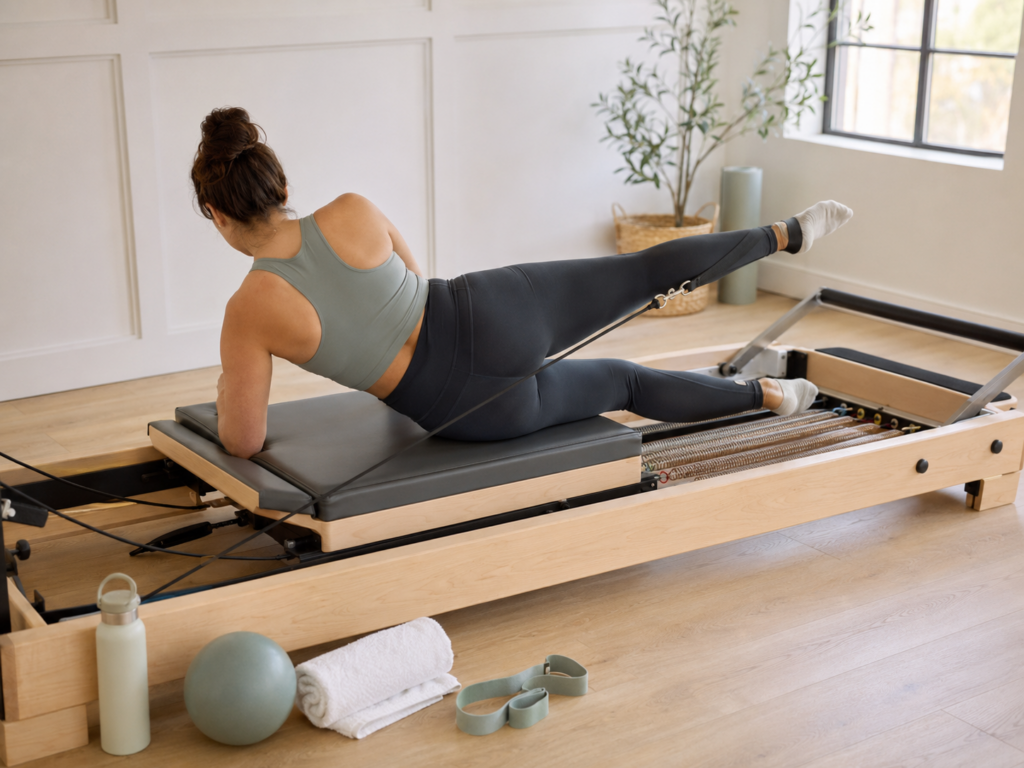
Is Pilates good for weight loss? Yes — but probably not for the reasons you’ve been told.
Studio blogs are telling you Pilates torches calories, sculpts your core, and melts fat. Medical sites are telling you Pilates is “low-impact” and you’d probably burn more calories walking. Reddit is somewhere in the middle, mostly people arguing.
Here’s what I can offer: I’ve played competitive sports well into my 30s, coached collegiate women’s lacrosse, trained with a personal trainer in strength and circuit work for nearly a decade, done 250+ CycleBar classes, ridden a 100-mile bike ride within three months of training, learned to skate on hockey skates in my late 20s to try out for an ice crew team, and logged 200+ Pilates and barre classes on top of all of it. I also have a health coaching certification.
What that adds up to isn’t just experience — it’s the specific perspective of someone who’s actually tried the workouts you’re comparing, at real intensity, over years, and watched what each one did to her body.
That’s the lens I’m going to use here. Every form of movement I’ve named is genuinely valuable.
But some of them are infrastructure — the load-bearing pieces you build a training life around — and some of them are supplemental.
Pilates falls into one of those categories more than the other, and knowing which is the difference between using it well and being frustrated that it isn’t doing what you hoped.
I’m going to give you the answer that actually helps you decide, not the one that sells classes or hedges to protect a medical disclaimer.
The short version: yes, Pilates supports weight loss. But it’s not a fat-burning workout. It’s the infrastructure that makes weight loss sustainable — which is a completely different job, and honestly a more important one.
Let’s get into what that actually means.
The Short Answer, No Hedging
Pilates supports weight loss. It doesn’t drive it.
If you’re eating in a caloric deficit and you add Pilates 3–4 times a week, you’ll likely lose weight and look leaner than the scale suggests.
If you’re not eating in a deficit and you add Pilates 3–4 times a week, you probably won’t lose weight, but you will get stronger, move better, and feel more capable in your body.
If you want Pilates to be the whole intervention, it won’t be. If you want it to be the piece that makes the whole intervention sustainable, it’s one of the best tools out there.
What Pilates Actually Does For Weight Loss
Pilates works on weight loss through four specific mechanisms, and they’re worth naming because most content skips this and jumps straight to “you’ll feel great.”
It Builds Lean Muscle And Raises Your Metabolic Rate
Not as much as heavy strength training does — I’ll get to that — but reformer Pilates in particular loads your muscles under tension for extended time under load. That’s a legitimate muscle-building stimulus, especially if you’re new to resistance work. More muscle means your body burns more calories at rest, all day, whether you’re moving or not.
It Improves Posture So You Look Leaner
This one gets brushed off as vanity, but it’s genuinely a size-perception thing. Pilates spends serious time on thoracic mobility, shoulder positioning, hip alignment, and deep core engagement. When your posture opens up, your midsection lengthens, your ribs stop compressing your waist, and you look like you’ve lost weight before the scale reflects it. This is why people who don’t lose a pound doing Pilates still say their clothes fit differently.
It Strengthens Your Core And Stabilizers
If you’re also walking, running, lifting, or doing anything else, a stronger core means better mechanics, less injury risk, and more work capacity. You can train harder because you’re not compensating around weaknesses. This is the invisible piece nobody credits Pilates for.
It Builds the Body Awareness That Changes Your Habits
This is the piece most fitness articles won’t touch because it’s hard to quantify. But knowing where your body is, how it feels, and what it needs shifts your relationship with food and rest in ways that no workout intensity ever does. Weight loss that lasts is usually downstream of that shift.
What Pilates Doesn’t Do
Here’s the part the studio marketing won’t tell you.
It Doesn’t Burn Cardio-Level Calories
A moderate reformer class burns somewhere around 175–375 calories depending on your body weight and the class intensity.
Compare that to running, cycling, or a heavy strength circuit and you’re looking at half to a third of the calorie output per hour. If your entire fat-loss plan is Pilates and nothing else, you’re going to be waiting a long time.
It Doesn’t Build Muscle Like Progressive Overload Lifting
Reformer springs give you resistance, and mat work gives you bodyweight load, but neither system lets you consistently add weight over months and years the way a barbell does.
You’ll get stronger — significantly stronger, especially through your posterior chain and core — but you won’t build the kind of muscle mass that dramatically shifts your metabolism.
It Doesn’t Replace Cardiovascular Conditioning
Your heart is a muscle too, and it needs specific stimulus — zone 2 work, some intervals — to stay strong.
Pilates keeps you moving but doesn’t push your heart into training zones for long enough to count as cardio for most people.
It Doesn’t Create a Caloric Deficit On Its Own
No workout does. Weight loss is a nutrition equation with movement as a supporting variable. If you don’t want to hear that, no article about any workout will actually help you.
Naming what Pilates doesn’t do is what makes the “yes” credible. It’s a real tool with a real job. It’s not a shortcut.
Is Reformer Pilates Better For Weight Loss Than Mat?
Reformer gets you closer to a strength-training stimulus. Mat is more accessible.
Reformer Pilates adds variable resistance through the spring system, which means you can load your muscles more heavily and get more measurable strength gains over time.
If muscle-building is a priority — and it should be, because muscle is the metabolic tissue that supports long-term weight loss — reformer is the better tool.
Mat Pilates is bodyweight-only, which caps the load but removes every access barrier. You can do it in your living room for free.
For core strength, mobility, and body awareness, mat is genuinely great. For weight loss specifically, it works best when it’s paired with something that provides more resistance elsewhere in your week.
If you can only do one and you want weight loss support: reformer, if you can afford it. If cost is the deciding factor: mat plus a set of light dumbbells or resistance bands does most of what reformer does.
My Club Pilates review walks through what reformer classes are actually like if you’re weighing whether to try one.
How Often Should You Do Pilates To Lose Weight?
Three to four times a week if it’s your primary form of movement.
Less than that and you’ll maintain what you’ve got but you won’t build enough muscle or momentum to support fat loss. More than that and you’re stealing recovery capacity from other things your body needs — walking, sleep, whatever cardio or strength work is also in your rotation.
The sample week that actually works:
- Monday: Reformer or mat Pilates
- Tuesday: 30–45 minutes of walking or zone 2 cardio
- Wednesday: Reformer or mat Pilates
- Thursday: One strength training session (even bodyweight counts)
- Friday: Reformer or mat Pilates
- Saturday: Longer walk, hike, bike ride, or rest
- Sunday: Optional mat Pilates or full rest
That’s three Pilates sessions, some cardio, one strength session, and real recovery. It’s not glamorous, but it’s the structure that actually produces results for most people who aren’t training for something specific.
Pilates Versus Other Workouts For Weight Loss
Fitness content loves the versus format. Here’s the real answer for each of the common ones.
Pilates vs Weight Lifting
Weight lifting wins for pure fat loss and body composition change. Full stop.
Progressive overload with heavy weights builds more muscle, burns more calories both during and after training, and creates the metabolic shift that supports long-term leanness.
Pilates is a fantastic complement to lifting — it protects your joints, improves your lifts, and prevents the injuries that derail most strength programs — but it’s not a replacement.
If you have to choose one, and weight loss is the priority, lift.
Pilates vs Yoga
For weight loss specifically, Pilates has a slight edge because reformer work builds more measurable strength than most yoga styles. Power yoga and hot yoga close the gap. If you’re comparing gentle yoga to reformer Pilates, Pilates wins for body composition. If you’re comparing them for stress management, mobility, or nervous system regulation, yoga probably wins. They’re different tools.
Pilates vs Walking
Walking burns more calories per hour and requires zero equipment or class fees, so if you’re optimizing for the cheapest fastest thing you can do, walking wins. Pilates builds strength that walking doesn’t. The right answer is almost always both.
Pilates vs Running
Running burns more calories per hour by a significant margin. Pilates protects your body from the injuries running eventually causes. If you love running, use Pilates as insurance. If you don’t love running, don’t force it — Pilates plus walking gets you most of the way there without the injury risk.
Pilates vs HIIT
HIIT burns more calories and creates a bigger post-workout metabolic bump. Pilates supports the recovery you need to actually keep doing HIIT sustainably. If you can do both across a week, do both. If you have to pick one, HIIT for faster fat loss, Pilates for sustainability.
The pattern here: nothing beats Pilates at what Pilates does. Nothing beats other workouts at what other workouts do. Weight loss happens fastest when you use them for what they’re actually good for.
How To Actually Use Pilates As Part Of a Weight Loss Approach
Here’s the framework that works.
Nutrition Does the Heavy Lifting
A modest caloric deficit — 300 to 500 calories below maintenance — is what drives fat loss. Pilates doesn’t create that deficit; your food choices do. If you’re not paying attention to what and how much you’re eating, no workout schedule will get you there.
Strength Training Builds Your Metabolic Engine
One or two strength sessions a week alongside your Pilates work. This doesn’t have to be a barbell in a gym — bodyweight strength circuits count, dumbbells at home count, resistance bands count. The goal is progressive overload: doing a little more over time.
Zone 2 Cardio Fills In the Aerobic Gap
Walking, easy cycling, easy swimming — long enough to hold a conversation, hard enough that you’re breathing more than at rest. 150 minutes a week across a few sessions is the number most research points to.
Pilates Is the Connective Tissue
Three or four sessions a week. It’s what keeps you mobile, strong through your core, aware of your body, and unlikely to get injured. It’s also the workout you’ll actually keep doing five years from now, which is what matters most.
Sleep And Recovery Are Non-Negotiable
This is where most weight loss efforts fall apart. Under-slept bodies hold onto fat and drive cravings. Seven to nine hours, consistent bedtime, dark room.
If your mattress isn’t supporting recovery, that’s worth addressing.
Pilates fits inside this system. It’s not the system.
Best Pilates Moves If Weight Loss Is Your Goal
If you’re going to prioritize the moves that give you the most weight-loss-supportive stimulus per minute, focus on compound work that hits multiple large muscle groups at once.
The Hundred
The classic core opener. Builds abdominal endurance and gets your heart rate up faster than most Pilates moves.
Teaser
Full-body integration. Hits your abs, hip flexors, and postural muscles simultaneously. Hard, and worth it.
Plank Variations
Standard plank, side plank, plank with knee taps. Full-body isometric work that builds core, shoulder, and hip stability all at once.
Reformer Footwork
If you’re on a reformer, footwork loaded with heavy springs is your closest analog to a leg press. Legs and glutes are your largest muscles — training them matters most for metabolic impact.
Side-Lying Series
Underrated. Loads your glute medius, which most people are chronically weak in. Strong glutes improve everything from walking to running to standing posture.
Roll-Ups And Roll-Overs
Move your spine through its full range while loading your abs eccentrically. Great for the “long lean” look and for functional core strength.
If you’re doing mat Pilates at home and want to make it more weight-loss-supportive, add a set of light dumbbells (three to five pounds is plenty) or a resistance band. A small equipment upgrade turns a mobility workout into a strength workout without changing the flow.
Can You Do Pilates For Weight Loss At Home?
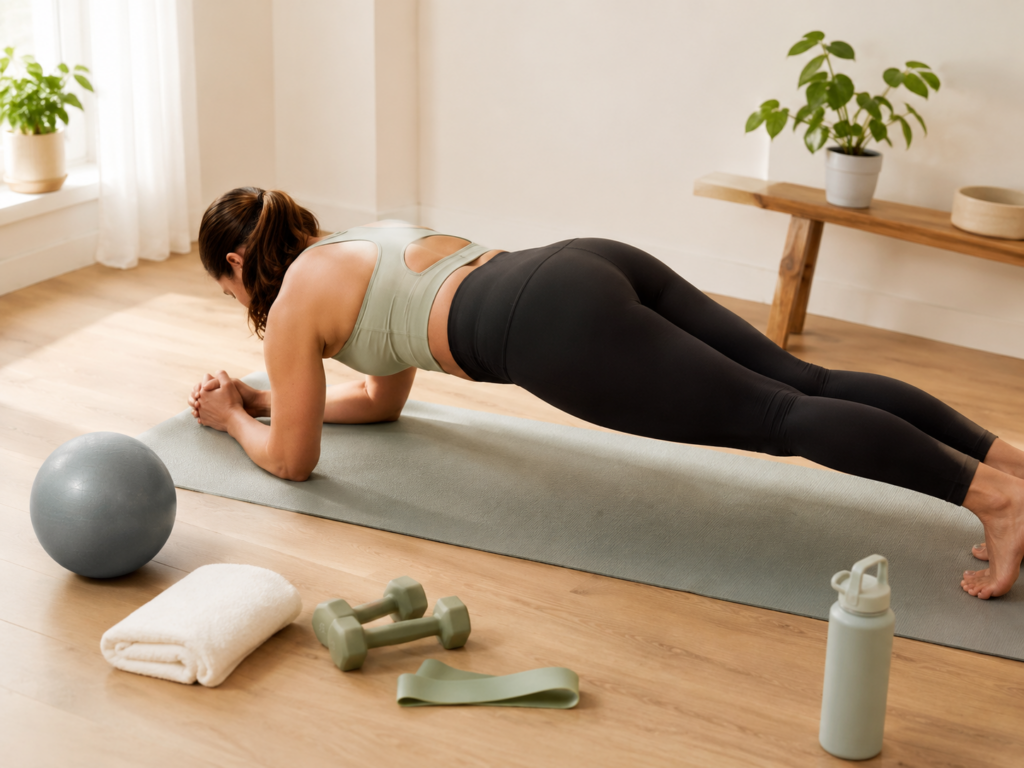
Yes. Mat Pilates is fully accessible from your living room floor.
You need one thing: a decent mat. Yoga mats work, but a slightly thicker Pilates-specific mat is more comfortable for the roll-based work.
This is the mat I recommend — thick enough for spinal work, dense enough not to slide, and big enough to establish a space for your home workouts.
Optional but genuinely helpful additions:
- A small Pilates ball for glute bridges, inner thigh work, and adding challenge to seated moves
- A resistance band or long loop band to mimic reformer resistance
- Light dumbbells — three, five, and eight pounds is a solid starter set for adding load to standing work and turning some sequences into strength circuits
For instruction, the two most reputable at-home platforms are Pilates Anytime and Pilatesology.
Pilates Anytime has the deeper library and more instructor variety. Pilatesology leans more classical if that’s what you’re after. YouTube is fine for beginners — Move With Nicole and Lottie Murphy have accessible free content — but a paid subscription is worth it once you’re doing this seriously.
If you want reformer at home, machines exist, but they’re a serious investment. For most people, a studio membership or a small-group reformer package is more cost-effective than buying a reformer for their basement.
When Pilates Won’t Get You There
There are situations where Pilates alone isn’t going to move the needle. Worth naming them honestly.
When Your Nutrition Isn’t Aligned With Your Goal
Three Pilates classes a week alongside daily fast food and inconsistent meals won’t produce weight loss. This isn’t a moral judgment — it’s just math.
Food matters more than movement for fat loss.
If you’re not ready to look at food, work on food first, and let Pilates be a supportive habit rather than the whole plan.
When You’re Not Doing Strength Work Anywhere Else
Pilates provides some resistance stimulus, but not enough to build the kind of muscle that reshapes body composition on its own.
If reformer is your only resistance work and you’re not seeing changes, adding a single strength session per week — even a 30-minute
When You’re Using Pilates To Compensate For Under-Eating
Some people show up to Pilates already eating too little and hoping the workouts will finally give them the leanness they’ve been chasing. This backfires.
Under-eating combined with under-fueled training makes your body hold onto fat, drop muscle, and downregulate every system that matters.
If this feels close to home, weight loss isn’t the right goal to be chasing right now. Getting your intake back to a sustainable place is.
When You Hate Every Second Of It
Pilates is only useful if you actually do it. If you dread every class and force yourself to go, that’s a signal to try a different modality.
There is no “best workout for weight loss.” The best one is the one you’ll do consistently for years.
Frequently Asked Questions
Can You Lose Belly Fat With Pilates?
You can lose overall body fat with a caloric deficit, and Pilates can support that. But spot reduction — losing fat specifically from your belly by doing ab-focused workouts — isn’t how the body works. Pilates will strengthen your core and improve your posture, both of which change how your midsection looks. Actual belly fat loss happens through overall fat loss, which is a nutrition and full-body training conversation.
How Long Until You See Results From Pilates?
Body awareness and posture changes show up in two to four weeks. Strength changes are noticeable at six to eight weeks. Visible body composition changes generally take twelve weeks or more of consistent practice paired with aligned nutrition. If you’re expecting scale movement in three weeks, that expectation is doing you a disservice.
Will Pilates Make You Bulky?
No. Building the kind of muscle mass that reads as “bulky” requires heavy progressive overload, high protein intake, and often years of consistent effort. Pilates produces long, functional, capable muscle. If you’re worried about looking bigger from Pilates, you can let that worry go entirely.
Is Pilates Enough On Its Own For Weight Loss?
For most people, no. It works best paired with aligned nutrition, some strength training, and some cardiovascular work. As part of a full approach, it’s genuinely powerful. As the whole approach, it’s incomplete.
What Type Of Pilates Is Best For Weight Loss?
Reformer with a challenging instructor, if you have access. Contemporary or athletic-style mat classes if you don’t. Slower classical Pilates is beautiful but less metabolically demanding. Match the style to the goal.
Is Pilates Good For Beginners Who Want To Lose Weight?
Yes — start there. Pilates teaches you how to move well, which is the foundation for every other kind of training you might add later. Beginners often see meaningful strength and posture changes in the first six to eight weeks. Just don’t expect it to be the whole answer.
Pilates As Infrastructure, Not a Fat Burner
The reframe that changes everything: Pilates isn’t a weight loss workout. It’s what makes a weight loss approach sustainable.
The core strength, the joint integrity, the body awareness, the injury prevention — that’s what keeps you consistent five years from now.
And consistency, not intensity, is what actually produces the body composition change most people are searching for when they type “is Pilates good for weight loss” into Google at 11 p.m.
If you’re looking for the workout that burns the most calories in the shortest time, Pilates isn’t it.
If you’re looking for the workout that keeps you strong, mobile, self-aware, and in the game for decades, Pilates is one of the best there is. When you pair it with aligned nutrition, some strength work, and some cardio, weight loss follows.
That’s the honest answer.
If you’re still figuring out whether Pilates is your thing at all, here’s my complete guide to what Pilates actually is and here’s whether the modality is worth it in the first place. If you’re specifically weighing Pilates against lifting, the full pilates-versus-strength-training breakdown lives here. And if you’re considering trying a reformer studio, my honest Club Pilates review walks through what to expect from your first class.
Whatever you choose, choose the version that keeps you moving. That’s the only version that works.



Get the Weekly Wellth Newsletter
Stay up to date & receive the latest posts in your inbox.