


Budget-Friendly Home Gym Equipment For Women: The Staples Worth Buying
You don’t need a spare room, a wall of machines, or a standing membership to get strong and stay mobile at home. You need a short list of staples that cover how you actually want to move — and once you own them, you’re set for years.
Most home gym roundups get this wrong in one of two directions.
They either bury you in twenty gadgets you’ll use once, or they hand you a pair of three-pound weights and call it strength training. Neither is what a woman actually needs.
This is the budget-friendly home gym equipment I’d actually tell a friend to buy — ten essentials that cover strength, power, cardio, mobility, and recovery, plus an honest take on what to skip. Most of it fits in a single basket, and the whole thing costs less than a few months of a studio membership. Unlike the membership, you buy it once.
This article contains affiliate links. If you buy through them, Reach Wellth may earn a small commission at no extra cost to you.
Budget-Friendly Home Gym Equipment: The Staples You Need And Nothing You Don’t
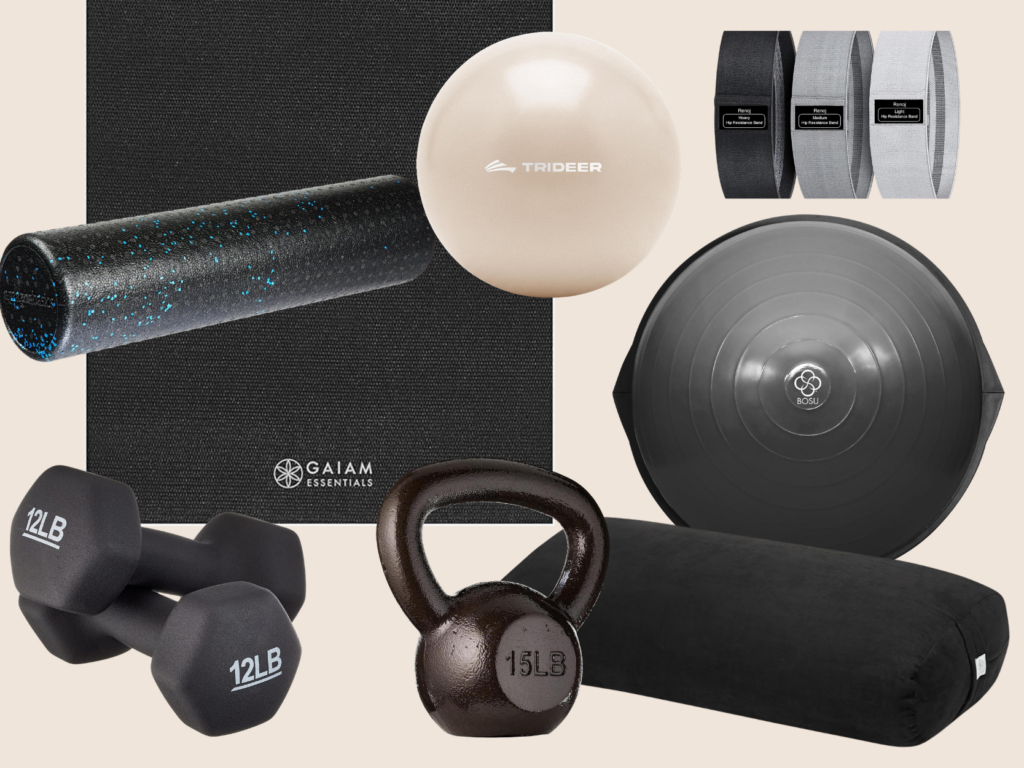
Here’s the whole setup, grouped by what it does — seven staples plus one optional extra. Own these and you’ve covered roughly everything most women need at home.
- Foundation: a nonslip exercise mat (from low-budget to longest lasting)
- Strength: a full
dumbbell set (5–20 lb), akettlebell (25–30 lb), and a BOSU balance trainer - Studio classes at home: mini
resistance bands and acore ball - Recovery: a foam roller
- Mindfulness: no purchase required (but one item is a worthwhile nice-to-have)
Why These Earn Their Place
I built this the way I’d build it for a friend who wanted one setup that lasts.
As a holistic health coach who prioritizes workouts, especially strength-training every week, this is close to what I actually own — and every piece here does at least two jobs, holds up over time, and supports a real, well-rounded routine instead of one type of workout.
Nothing on the core list is a gimmick, and nothing requires drilling into a wall or clearing out a room.
The logic is straightforward: your body needs to move, to get stronger, to recover, and to settle. Cover those four and you have a complete practice.
The pieces below map to exactly that.
Start With The Foundation: Your Exercise Mat
Before anything else, you need a good surface. A mat is the base layer for nearly all of it — floor work, a strength circuit, a stretch, a few quiet minutes of breathing.
Look for roughly 5–8mm of thickness: enough cushion for kneeling and floor work without feeling so soft that you wobble during standing strength moves, plus a nonslip surface on both sides.
One thing worth knowing before you buy: a standard
A solid standard-size mat works if you’re short on space or want to spend the least; going wider is the upgrade if you have the room. My full breakdown of extra-large mats lives here if you want the deep dive.
Here are three worth your money, from most accessible to buy-it-for-life.
The Budget-Friendly Pick

If you want a dependable everyday mat without the extra-large footprint or the higher price, the Gaiam Essentials 6mm is the more affordable option here.
The 6mm cushioning supports your joints for floor work, it holds up for yoga, Pilates, and general workouts, and it comes with an easy-cinch carry strap so it’s simple to roll up and stash. It’s the right pick if you’re tight on space, brand new to a home practice, or just want to spend the least and start moving.
The One for a Bigger Workout Space
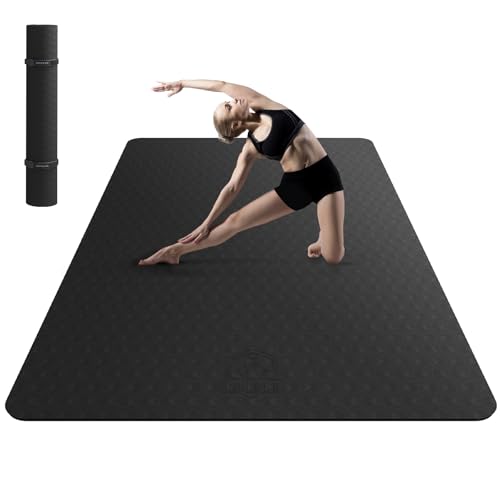
The 72″×48″ Hapbear is the 6mm mat I reach for daily — strength, Pilates, yoga, HIIT, stretching, all of it.
Double-sided nonslip so it grips on both faces, wide enough to keep your hands and feet on the mat through any movement, and it rolls into an included carry bag. For most people, this is the mat.
The Buy-It-For-Life Upgrade

If you want one mat that outlasts everything, the Manduka Pro is the premium, natural-rubber option with a lifetime guarantee on the Pro line. It runs two to three times the price of the Hapbear, but it’s the last mat you’ll ever buy.
Strength: Dumbbells And A Kettlebell
This is where most women underbuy, and it’s the most important thing to get right.
Three-pound weights are fine for a high-rep arm burn, but they are not strength training — and treating them like they are is how you can work out for years without getting meaningfully stronger.
Strength matters more as we move through our late thirties and forties, not less.
It’s how we hold onto muscle and protect bone density through the years when both naturally start to decline.
Federal physical activity guidelines recommend muscle-strengthening activity that works all the major muscle groups at least twice a week — using enough weight that your last few reps are genuinely hard while your form stays clean.
For most women, that means lifting heavier than they think, and progressing over time.
Here’s the fuller case for prioritizing it, and how strength training compares to Pilates if you’re deciding where to spend your energy.
A Full Dumbbell Set (5, 8, 10, 12, 15, 20 lb)

Buy a set. Grabbing a few sets of
A complete set is a one-time purchase, it stores in a corner, and you’ll reach for it more than anything else in your home.
Skip the adjustable-dumbbell gadgets; a plain set is more durable, faster to grab mid-workout, and often cheaper than you’d expect.
A Kettlebell (25–30 lb)

One solid kettlebell unlocks movements
Medicine Ball
A medicine ball adds power and rotation to a strength routine — the stuff weights alone don’t cover. Slams, wall throws, weighted squats and lunges, Russian twists, and overhead work all live here, and it builds the explosive, full-body strength that keeps you capable. A soft slam-style ball around 8 to 10 pounds is the most versatile starting point: no bounce, safe on floors, forgiving on your wrists.
- Shop the medicine ball →
BOSU Balance Trainer

A BOSU turns basic moves into full-body work. Pushups with your hands on the dome, lunges with your back foot on it, squats and planks that suddenly demand your stabilizers — it’s one piece that makes bodyweight and light-weight work meaningfully harder while training the balance that protects your joints. It also doubles as a step for core work and a prop for stretching.
Studio Classes At Home: Barre, Pilates And Yoga
Plenty of people build their whole routine around at-home studio-style classes — barre3, Pilates, yoga, or an app like Ladders, Evolve You, or a Tone It Up-style flow you follow along to. You need almost nothing to do them well, but two small pieces cover most of what an instructor would hand you.
Resistance Bands
![Booty Resistance Bands Set, Renoj Non Slip Hip Exercise Bands for Legs and Butt Women [3 Set]](https://m.media-amazon.com/images/I/61kFsOUspAL._SL500_.jpg)
Fabric resistance bands sit above your knees or around your ankles to fire up your glutes and outer hips — the muscles that quietly stabilize everything else. They’re what you’ll use for monster walks and lateral work, whether that’s inside a class or as a two-minute activation before you lift. Choose a set with a few resistance levels and a nonslip fabric interior; the fabric versions stay put where thin rubber bands roll and pinch.
Step into them for monster walks and lateral walks to fire up your glutes and outer hips before you lift. Hold them long for assisted hamstring, hip, and shoulder stretches. Loop them for banded squats, presses, and pull-aparts. They do the job of three separate props, they cost almost nothing, and they pack into a drawer or a suitcase. Get a set with a few resistance levels so you can progress.
- Shop fabric resistance bands →
- Shop long
resistance bands →
Core Ball

A small inflatable core ball is the one prop that shows up again and again in barre and Pilates flows. It adds resistance to core work, gives your inner thighs something to squeeze, and slides behind your low back for supported ab work. It deflates flat for storage and costs next to nothing.
If you’re curious whether a studio membership is worth it before you commit, here’s my honest take on Club Pilates.
Jump Rope
The cheapest, most portable cardio you can own — and some of the most effective. A few rounds of jump rope spikes your heart rate faster than almost anything else, it fits in a bag, and it turns two minutes between strength sets into real conditioning. For a home setup where space and time are tight, nothing else does this much for this little. A basic adjustable speed rope is all you need.
- Shop jump ropes →
Recovery
Stretching is recovery — the two aren’t separate pillars, they’re the same job. And it’s the part most people skip right up until their back tightens and their hips stop cooperating. Two inexpensive pieces make it far more likely you’ll actually do it.
Foam Roller
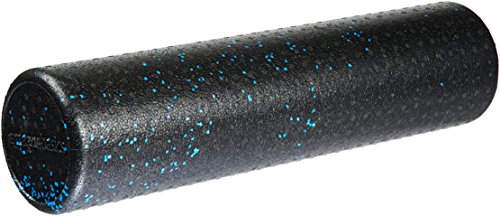
A foam roller is your recovery workhorse. Roll out tight quads, calves, and your upper back after a strength session or a long day at a desk.
A compact roller stores easily and travels well; a firmer density gives you more release once you’re used to it.
If you want a gentler on-ramp to mobility and calm, reconnecting through a simple yoga practice pairs perfectly with this.
Mindfulness
The last thing your body needs is to down-regulate — and this is the pillar that requires nothing on your shopping list. Your mat and a few honest minutes cover it.
You don’t need to buy anything to sit quietly and let your nervous system come down after a hard day; the willingness to actually stop is the whole tool.
Here’s how to build real rest into a genuinely full schedule without adding one more thing to your list.
That said, a bolster pillow is a genuinely nice add if you want one. It makes sitting for a few minutes far more comfortable, so you’re more likely to do it — and it does double duty for your body, too: lie back with it positioned just under your tailbone and it becomes a gentle way to open through your hips and low back.
Not a must, but a small piece that earns its keep.
What You Can Skip And Why
Half of building a smart home gym is knowing what not to buy. These show up on every roundup, and I’d leave them off:
- Adjustable
dumbbells . They cost more than a plain set, break more often, and slow you down mid-workout. Buy the fixed set. - Long resistance-band-and-door-anchor systems. They look versatile in the box and end up in a drawer. Your
dumbbells ,kettlebell , and mini bands already cover pushing, pulling, and activation. - Yoga blocks. If you already own one, keep it — but a matching pair isn’t something most people need to go buy. A sturdy book or a folded towel fills in when a pose calls for a lift.
- Yoga bolsters. Nice if you’re deep into restorative yoga, but not a staple. A folded blanket does the same job for most people.
- Sliders. Cheap and fun, but redundant next to a BOSU and bodyweight work. Paper plates or moving sliders work in a pinch if you want to try them.
- Anything marketed as your “strength” solution that maxes out at 3 pounds. It isn’t. See above.
The Real Budget Play: Buy Once, Buy Well
Budget-friendly doesn’t mean cheapest. It means buying the right staples one time so you never rebuy them.
A plain
The smartest way to do it: don’t pay full price.
Major retailers run their deepest fitness discounts around Black Friday, so if you’re going to buy new, buy in that window — it’s genuinely possible to pick up nearly this entire list at half off in one shot.
Weights and mats also hold up beautifully secondhand, which makes them perfect for Facebook Marketplace: a set of
There’s no rush to buy everything at once, either. Start with a mat and your
Consistency matters far more than owning it all on day one, and the easiest routine to keep is the one that fits your real life.
Frequently Asked Questions
What home gym equipment do you actually need?
A nonslip mat, a full
What weights should a woman start with at home?
For strength training, a set that runs from about 5 to 20 pounds covers most women — lighter for smaller muscle groups, heavier for the bigger lifts. The right weight is one that makes your last few reps genuinely difficult while your form stays clean, and you progress up from there as you get stronger.
Do I need a kettlebell if I have dumbbells ?
They’re not redundant. A
Is a BOSU ball worth it?
Yes, if you want one piece that makes bodyweight work harder. It adds instability to pushups, lunges, squats, and planks, which trains your stabilizers and balance — and it doubles as a step and a stretching prop.
How do I build a home gym without wasting money?
Buy quality staples once instead of cheap gear you’ll replace, and shop the big sale windows like Black Friday when you can often get the whole setup at a steep discount. Weights and mats also hold up well secondhand, so Facebook Marketplace is a smart place to find
Can you get strong with just dumbbells and a kettlebell ?
Absolutely. Between them you can train every major movement pattern — pushing, pulling, squatting, hinging, and carrying. Add bodyweight work and progress the load over time, and that’s a complete, effective strength routine with no machines required.



Get the Weekly Wellth Newsletter
Stay up to date & receive the latest posts in your inbox.