



Newborn Registry Must-Haves: The 10 Essentials I Actually Used (and What to Skip)
Building a newborn registry is overwhelming in a specific way.
Newborn registry must-haves get thrown at you from every direction the moment people find out you’re pregnant — influencer hauls, $300 “breathable” crib mattresses, four versions of the same diaper bag.
Most of what shows up in your feed won’t survive the first three months.
These are the newborn registry must-haves I actually used as a first-time mom.
I’m seven months in now, which is enough time to see what gets daily use, what got donated by month three, and what I wish I’d skipped completely.
Below are the ten newborn essentials worth adding to your registry, the one bonus item I’d add again, and an honest list of what to skip so you can save the money for what actually matters.
If you’re earlier in the prep stage, self-care during pregnancy is a good companion read.
How I Chose These Newborn Must-Haves
Most newborn registry lists are aspirational, sponsorship-driven, or both. This one is neither. Every product below earned its spot because it met at least three of these:
- Daily use. I reach for it consistently — not once a week, not “sometimes.” Daily.
- Longevity past six months. The newborn-only phase is short and expensive. Most of what’s on this list still gets daily use at seven months in.
- Easy to use solo. If I couldn’t operate it one-handed during a 3 a.m. feed, it didn’t earn its spot.
- Multi-functional. One item solving two problems beats two items solving one each (the Hatch Rest is a sound machine, nightlight, and wake-up cue — that’s why it leads its section).
- Worth the price over time. Some things justify a splurge because they work for years (Uppababy, Spectra). Most don’t — and the “what to skip” section covers those.
If a product hit three of these, it made the list. If it hit all five, it’s leading a section.
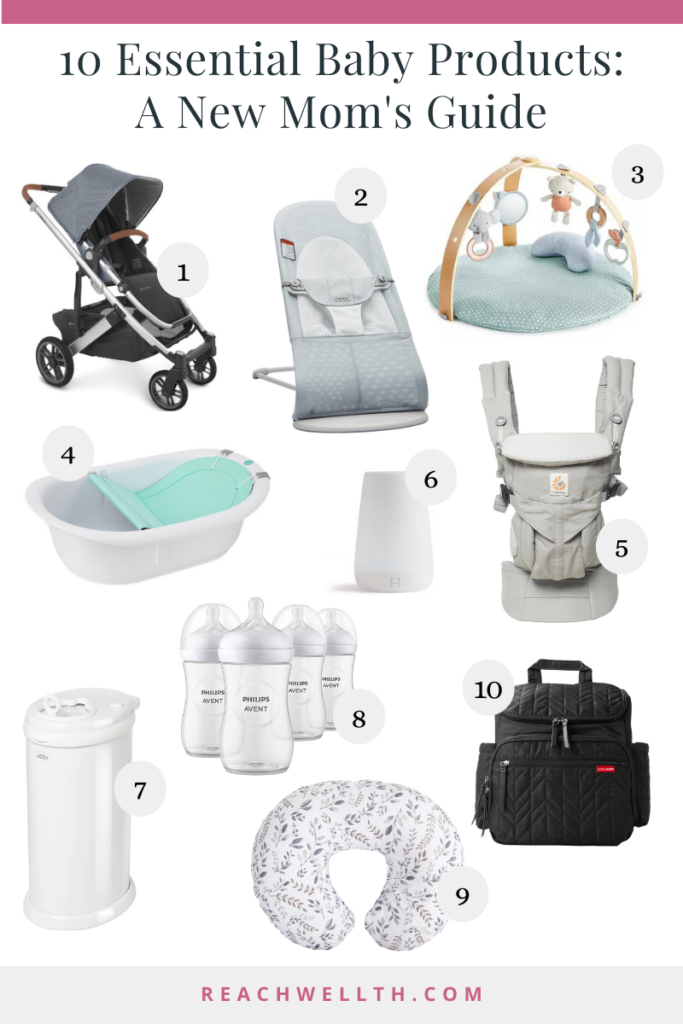
The 10 Newborn Must-Haves Worth Adding To Your Registry
Each section below covers a category — sleep, bath, bottles, and so on. Most include a few items that work together as a system, not just one product.
The “10” isn’t a product count; it’s the ten areas your registry actually needs to cover.
1. Stroller + Car Seat Combo
You’ll want to leave the house, and you’ll want gear that doesn’t make leaving harder.
The stroller and car seat are the first items you’ll use — and the ones you’ll handle the most. Buying ones you actually like to operate makes a real difference.
I have the Uppababy Cruz — I paid $300 used on Facebook Marketplace versus $700+ retail, which is worth knowing if you’re open to it.
Instead of buying a bassinet attachment, I used the infant SnugSeat insert, which let me use the stroller from day one.
For the car seat, I went with the Uppababy Mesa so it would click directly into the stroller (you’ll need the Mesa-to-Cruz adapters for this — they aren’t included with either purchase, easy to miss on a registry).
Two accessories I’d add if you go with the Cruz or V3: the snack tray and the stroller organizer.
Both still earn their keep at seven months — the organizer holds water and snacks for zoo days and trips, and the snack tray became essential once he started reaching for things.
Skip the rest of the Uppababy accessory list, but these two are worth it.

2. Bouncer
At some point you need your hands free, and the floor isn’t always practical. A bouncer or a swing solves this — but you only need one. (More on that in the what-to-skip section.)
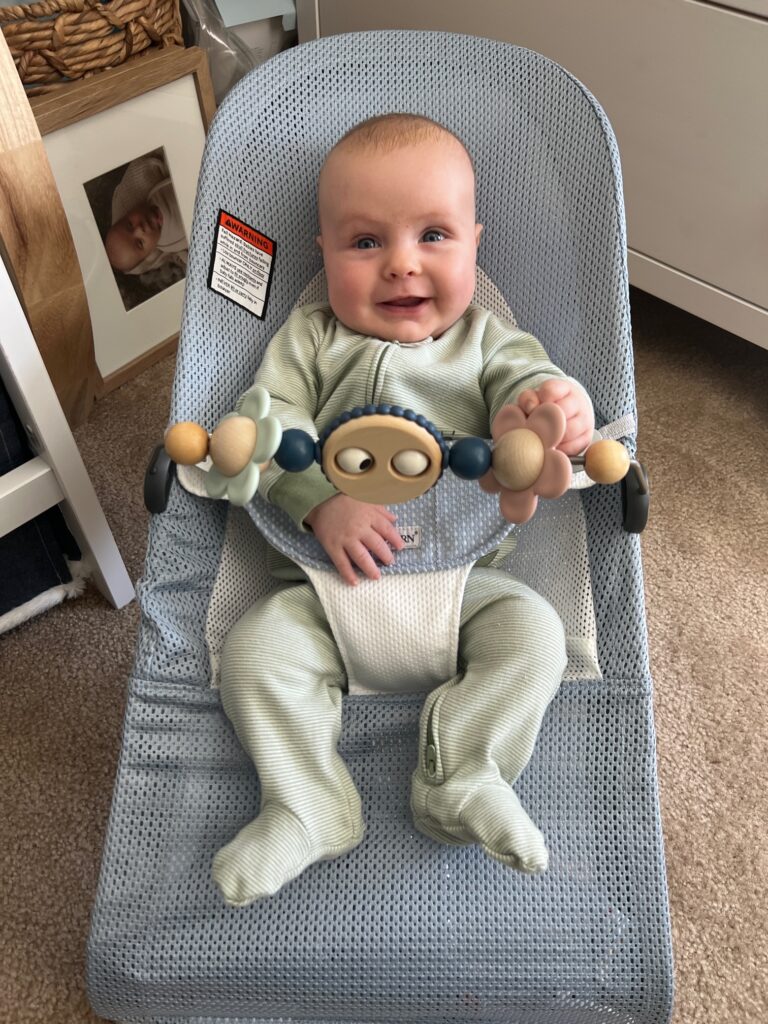
I used the BabyBjörn mesh bouncer the most. It’s light, easy to move room to room, and grows with the baby — my seven-month-old still uses it. The mesh is breathable and washable, which matters more than you’d think.
For the early newborn phase, I also leaned on a baby lounger. I’d set him down on it during the day, and I felt better about him napping on it than in the swing’s inclined position. I still set him on it when I give him a bottle.
Instead of a swing, I used my baby lounger a lot more.
You can set your baby down safety before they roll and if my baby fell asleep on it, I didn’t worry as much about his breathing as I did while he was inclined in the swing.
I still set my baby on this with a pillow underneath when I give him a bottle.
3. Activity Gym + Play Mat
A newborn doesn’t actually need a play mat — they sleep most of the time — but once they’re awake more, you’ll want something visually engaging to put them on.
The Ingenuity Cozy Spot activity gym and play mat is well-designed, folds flat, and didn’t make my living room look like a daycare.
By five months he was outgrowing it. This is one to buy within your budget, not splurge on — the window of use is short.
4. A Calmer Bath Setup
The FridaBaby 4-in-1 Grow with Me Bathtub has worked from newborn to over a year.
The seat adjusts based on your baby’s size, so they’re supported in the right amount of water at each stage. He feels secure, and I have more control.
The matching FridaBaby rinse cup sounds optional but isn’t — the soft lip on it actually keeps water out of their face.
I tried other bath supports (the Angelcare insert, for example) and they didn’t last past the first couple of months. The FridaBaby system is the only bath item I haven’t had to replace.
5. Baby Carrier
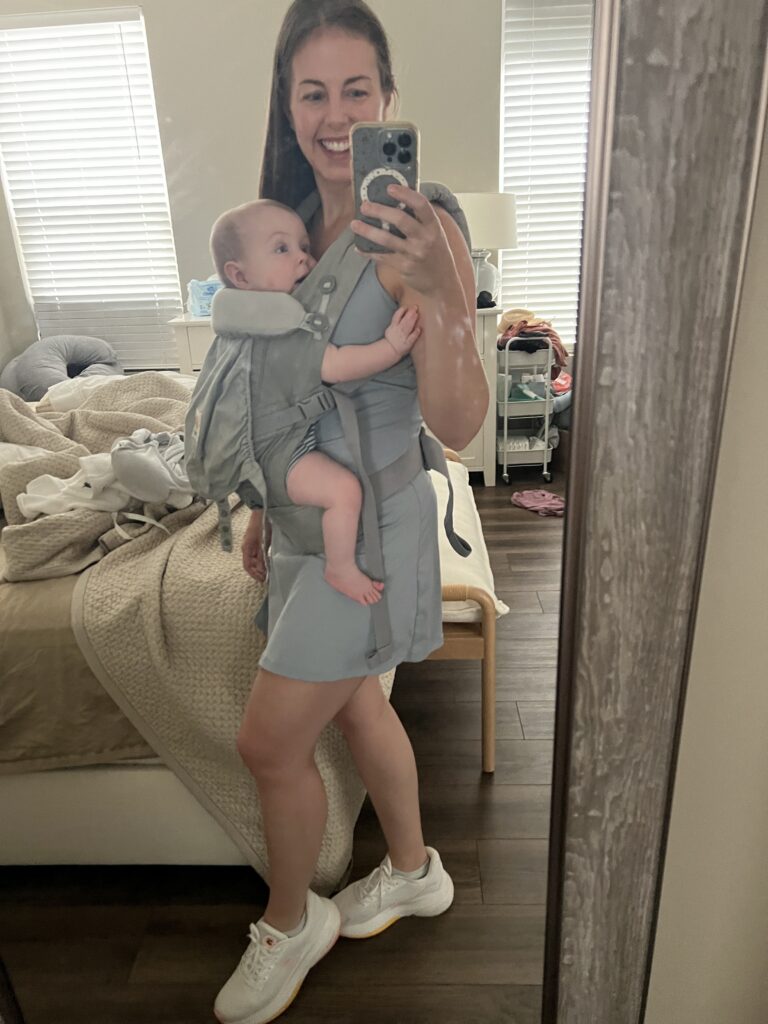
A carrier is how you get anything done without setting the baby down. It’s also one of the best tools for soothing a fussy or gassy baby. I use mine every morning for walks with the dog — it’s part of my weekday routine.
I prefer the Ergo Baby Carrier over Tula and other brands I’ve tried. It’s structured enough to distribute weight, easy to put on by yourself, and the buckle system is straightforward.
You do not need multiple carriers. I ended up with four (most were gifts), and the one I reach for most is a hand-me-down. One good carrier is enough.
6. Sound Sleep
The Hatch Rest Sound Machine is the one product I’d buy first if I were starting over.
It’s a sound machine, a nightlight, and a wake-up cue in one — controllable from your phone, schedulable, and quiet enough that it doesn’t startle you in the middle of the night. He still uses it nightly.
Honorable mention while we’re on Hatch: the Hatch Grow Smart Changing Pad and Scale runs on that same app.
You don’t need a fancy changing pad to track your baby’s progress, but if you’re already using Hatch for sleep, the integration is what makes it interesting — weight gain, diaper count, feeding patterns, and anything unusual I wanted to reference at the next pediatrician visit, all in one place.
Seeing the data laid out gave me real peace of mind when everything felt uncertain. By my own criteria the changing pad isn’t essential, but if you’re already running Hatch for sleep, it’s a natural add.
7. Stinky Diaper Solution
The Ubbi Diaper Pail and Ubbi trash bags do exactly what they’re supposed to.
The pail fills up about once a week, which lines up with trash pickup, and the steel construction actually contains the smell.
For the changing station itself, the OXO Diaper Caddy keeps everything in one place — diapers, wipes, ointment, a change of clothes — and it’s portable, so you can move it between rooms if you’re not always changing in the same spot.
8. Bottles + Formula System
My pick for bottles is the Philips Avent line — specifically the 4–8 oz Natural bottles.
The shape is comfortable to hold, and at 3–4 months he could hold it himself, which is genuinely useful when you’re trying to pump at the same time.
You can also add the full Avent Bottle Set as a single registry item if you want everything at once.
You’ll also want the Avent microwave sterilizer, which sanitizes a full set of bottles in three minutes.
The Avent bottle warmer is fine — honestly, bottle warmers across the board are mediocre, but this one works as well as any I’ve used.
If you’re formula feeding or supplementing (I was), the Baby Brezza formula dispenser is worth the spend.
It mixes bottles fast, at the right temperature, and saved me on days my supply ran low. This was a game changer when I started back at work too.
9. Breastfeeding + Pumping Gear
If you’re breastfeeding, real pumping supplies will save you.
I used the Spectra S1 Plus with multiple sets of extra pump parts — having two or three sets means you’re not washing parts between every session, which gives you back time you didn’t know you were losing.
The Kindred Bravely handsfree pumping and nursing bras are the only bras I’ve worn since.
I have three, and they cover everything from pumping at the desk to working out — once I was cleared and started working with a personal trainer again, these were the only bras that held up.
Skip the regular nursing bras you see on every registry list. I bought a few and never wore them.
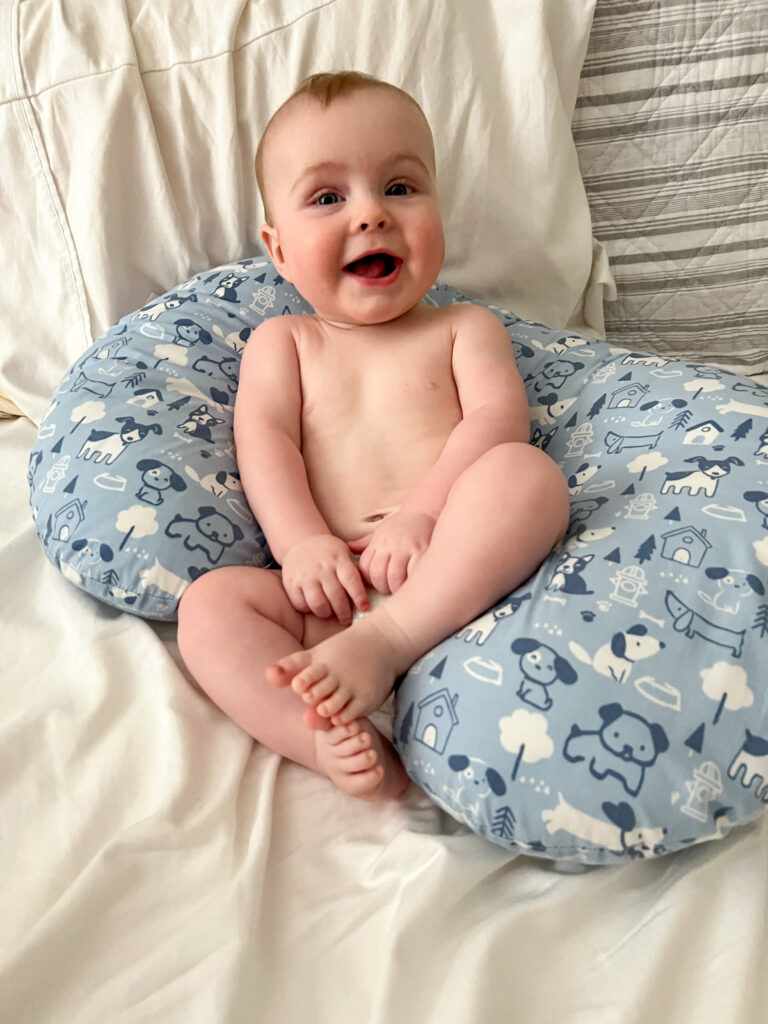
For nursing, the Boppy pillow is the standard for a reason. I still use it daily.
10. The Daily Supplies List
These are the items you’ll go through quickly and want stocked before baby arrives:
- A mommy duffle bag for overnight travel to visit family and friends
- Huggies diapers — my preference, but try a few brands
- WaterWipes or Huggies Natural wipes — both clean ingredients
- Vitamin A+D ointment for diaper rash, plus Aquaphor for general dryness
- Avent nipples in the next size up (4–6 months and beyond)
- Bottle cleaning supplies and brush and a drying rack
- Organic cotton crib sheets — 1 or 2 extras for the inevitable middle-of-the-night change
- KeaBabies washcloths (the softest I’ve found) and their baby food jars when solids start
- Swaddle blankets — versatile beyond sleep (nursing cover, stroller shade, blanket for you)
- Onesies and sleepers in every size
- One good diaper bag — the Skip Hop backpack is the one from my registry I still use daily
Having these on hand the first few weeks means you’re not running out to the store or scrambling for a delivery. That alone saves your sanity.
Bonus: The Baby Monitor I’d Buy Again
Calling this an “essential” is generous, but the Nanit Pro Baby Monitor is the one extra I’d add to my registry without hesitation.
The video quality is the best I’ve used, the sleep tracking is genuinely informative, and the breathing sock gives you peace of mind in the newborn phase.
My only regret: I waited to set it up until he was four months and moved into his own room. The breathing sock and temperature/humidity tracking are most useful in those early weeks — set it up before they arrive.
What to Skip on Your Newborn Registry
Here’s where I’d save you the money. These showed up on every list I read and didn’t earn their spot in my home.
A rocking chair. I thought I’d live in a glider. I barely sat in mine. Middle-of-the-night feedings and post-nap cuddles happened on the couch or in bed, where I was already comfortable. If you have hand-me-down options or already own a chair you like, start there.
A baby swing in addition to a bouncer. Pick one. Between the floor play mat and the bouncer, I never reached for the swing. By a few months in he was too big for it anyway. A swing is fine if it’s your only option, but you do not need both.
A “breathable” $300 crib mattress. Every newborn mattress sold today meets safety standards. You don’t need to spend triple for “breathable” branding — it’s a marketing layer, not a meaningful upgrade. A standard, certified crib mattress is fine.
A car seat cover. I used mine maybe twice. If it’s cold enough that I needed a cover, a blanket draped over the car seat covered the same use case. Most days, I just didn’t take him out.
A SNOObear. I loved mine, but the Hatch Rest already handled sound and light better. If you have one, you don’t need the other.
Multiple traditional nursing bras. The hands-free pumping and nursing bras (above) are the only style I wore. Buying a few regular nursing bras was a sunk cost.
More than one diaper bag or baby carrier. I ended up with several of each. I only really used one of each.
Plan for the Season Your Baby Arrives In
Your registry shifts depending on when baby comes.
My son was born in December, so a humidifier was on heavy rotation that first winter — dry air is hard on a newborn’s nose and skin, and a small cool-mist humidifier in the nursery made a real difference.
A summer baby might not need one for months.
Take a few minutes before baby’s arrival to map out what month they’ll be 1–3 months, 4–7 months, and beyond.
That helps you prep with the right items for the right window, instead of stockpiling things that don’t get used.
A Newborn Needs Less Than the Lists Suggest
Building a registry is exhausting because everyone is selling you something.
The honest version: your baby needs a fraction of what’s marketed to first-time parents. A safe place to sleep, something to eat from, a way to ride, something to wear. The rest is preference and lifestyle.
Most of the stress around “did I get the right thing?” disappears once baby arrives. You’ll figure out fast what works for your family, and you’ll be glad you didn’t go bigger.
If this list helps you skip one $300 mistake, it earned its place.
Most of all — you are the only thing your baby actually needs in those first months. Trust your instincts and tune out the rest of the noise.
Good luck and happy, healthy parenting!


Get the Weekly Wellth Newsletter
Stay up to date & receive the latest posts in your inbox.