



My New Year’s Eve at Home – Rituals for a Peaceful, Grounded Start to the Year
There’s this odd cultural expectation that New Year’s Eve should be loud, crowded, and overstimulating. But I’ve found that spending New Year’s Eve at home offers something far better: a calm, grounded start to the year that actually feels good.
Over time, I realized that the noise, the late nights, and the pressure to “make it a big deal” didn’t add anything meaningful to my life. What did? Waking up on January 1st feeling clear, rested, hydrated, and genuinely glad I didn’t spend the night performing celebration instead of enjoying it.
That’s what led me to create my own New Year’s Eve at home ritual—simple, cozy traditions that shift the night from chaotic to intentional without adding any extra work. Some years it’s just me and my son, some years friends join us, and every year it reminds me of the same truth:
Celebration doesn’t need spectacle to be meaningful. It just needs sincerity, comfort, and enough space to actually be present.
Here’s what my New Year’s Eve at home looks like—and why it works so well.

Permission to Celebrate at Home (And Actually Enjoy It)
I’ve had every kind of New Year’s Eve you can imagine — the crowded parties, the bar lines, the overpriced dinners, the “new year, new me” chaos.
Somewhere along the way, though, I realized none of that made me feel good. I don’t want to roll into January 1st exhausted or hungover or recovering from a night that was supposed to be “fun.”
But here’s what even the best party can’t give me:
waking up on January 1st feeling grounded, well-rested, and actually excited for a fresh start.
Choosing to spend New Year’s Eve at home isn’t a downgrade.
It’s an upgrade for your wellbeing.
If your body is craving quiet, if your mind is begging for less stimulation, if your nervous system is tired… staying home isn’t missing out.
It’s choosing something better.
Ritual 1: Clearing the Space to Create Calm
Before the night even begins, I do a quick reset of my home.
Not perfection—presence.
Laundry done.
Dishes away.
Counters wiped.
Clutter managed as much as possible with a three-year-old.
This isn’t about being Type A or having everything spotless.
It’s about reducing background stress.
When your space is visually calm, your brain feels calm.
That quietness lets you actually enjoy the evening instead of feeling like you’re sitting in a to-do list.
Clearing the space is my first ritual because it instantly lowers my mental load. It’s a tiny act of care for Future Me—and it makes the entire evening feel more grounded.
Ritual 2: Setting the Mood (Simple, Elevated, Zero Stress)
Once the house feels clear, I shift into setting the mood.
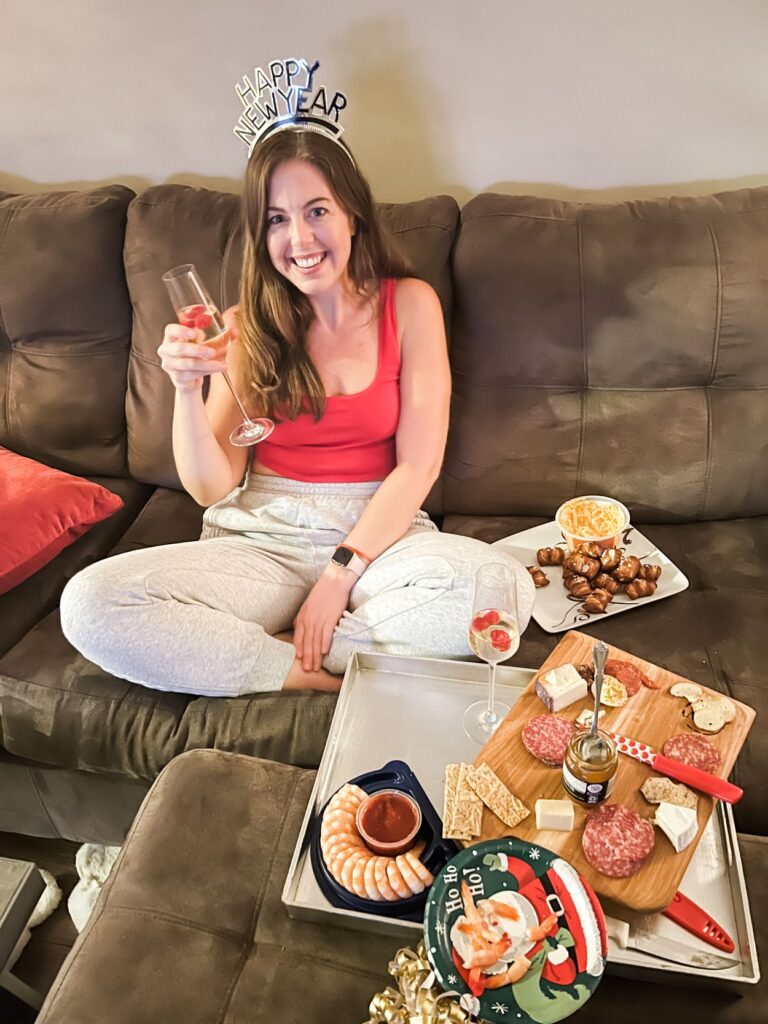
I leave my gold Christmas décor up—why take it down when it’s already festive? I add a star garland, put on a cheesy “Happy New Year” headband, and leave confetti poppers out for fun. It takes minutes, and the payoff is huge.
The ball drop is always on TV—sometimes muted, sometimes playing in the background. Not because I care about the broadcast, but because it gently marks the turning of the year.
The music sets the tone. Some years it’s mellow and reflective, some years it’s upbeat and danceable. This isn’t about aesthetics. It’s about creating an environment that feels intentional and warm—not performative.
Setting the mood is one of the simplest ways to shift from “regular night” to “soft celebration.” It signals that this moment matters.

Ritual 3: Food & Drinks That Feel Special Without Any Extra Work
I stopped cooking formal New Year’s Eve dinners years ago.
The amount of work never matched the vibe of the night.
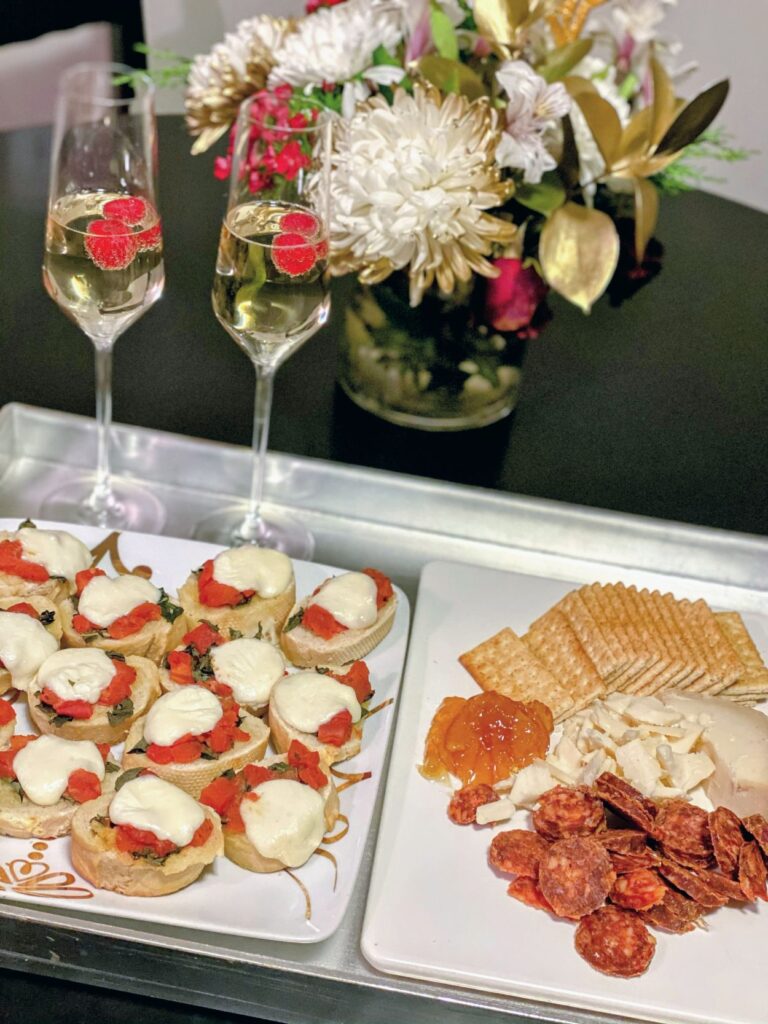
Instead, I make a charcuterie board with all my favorites:
- pretzels + beer cheese
- shrimp with cocktail sauce
- deviled eggs
- cheeses
- crackers
- salami
- pepperoni
- dips
It’s unfussy, flexible, and perfect for grazing.
Eating this way does something really important:
It removes pressure.
You’re not timing a meal. You’re not cleaning up dishes. You’re not stuck in the kitchen.
And then—my favorite part—champagne with raspberries.
It’s such a small ritual, but it marks the moment beautifully. I always make a version for my son too so he feels included. These tiny touches make the night feel special without draining energy.
This is the kind of “celebration” that supports your wellbeing instead of overwhelming it.

Ritual 4: Dancing as a Release
At some point in the evening, the music gets louder and we dance.
Sometimes it’s just me, shaking off the heaviness of the year.
Sometimes it’s me and my son, laughing and spinning in the living room.
Sometimes friends join in.
Dancing is my favorite ritual because it creates physical release.
Your body lets go of stress in a way your mind can’t do alone.
There’s no choreography, no performance, no expectation.
Just movement, joy, and the reminder that your body deserves moments like this.
We stay up as late as we want—no pressure, no rules.
Ritual 5: A Quiet Moment of Reflection
Right before midnight (or whenever the night starts to slow down), I take a moment to check in with myself.
It’s not journaling.
It’s not resolutions.
It’s not performing self-growth.
It’s a grounding pause.
I think about what I navigated, what I survived, what I learned. I give myself compassion. Sometimes I say “I love you.” Sometimes I acknowledge how hard the year was. Sometimes I feel proud. Sometimes I just feel relief.
Then I shift forward.
I finish the sentence:
“This is the year for…”
Whatever feels true—stability, health, joy, boundaries, better systems, new opportunities.
New Year’s Eve is too emotionally charged to plan anything new.
That’s why I do all my real planning in October.
But this moment helps me anchor my direction.
It helps me start the year aligned, not rushed.
If you haven’t chosen your Word of the Year yet, this is when it often reveals itself. Here’s how I choose mine: How to Choose Your Word of the Year for 2026 →
Ritual 6: The Toast (Whether It’s Midnight or Not)
If we make it to midnight, great.
If not—also great.
Some years we toast at 12.
Some years at 9pm.
Time is arbitrary. The moment is not.
It’s a soft, simple celebration. No pressure. No “perfect moment.” No performance.
Just a quiet acknowledgment that we made it.
That we’re here.
That the next chapter is beginning.
New Year’s Day: A Tradition That Feels Good
On January 1st, I always make pork and sauerkraut.
It’s a tradition I grew up with—symbolizing luck—but I love it for another reason:
It supports gut health (hello, prebiotics)
and
it’s grounding, simple, and comforting.
The perfect way to start the year.
You can get my easy crockpot Sauerkraut and Pork for New Year’s Day Recipe here →
What New Year’s Eve at Home Actually Gives You
A New Year’s Eve at home isn’t about doing less.
It’s about doing what actually supports you.
It gives you:
- a gentle start to the year
- a night without chaos
- energy instead of exhaustion
- presence instead of pressure
- a chance to anchor yourself
- meaningful tradition for your children
- celebration without overstimulation
- simplicity that still feels special
The magic of New Year’s Eve at home is this:
You don’t need noise, crowds, or performance to feel hopeful.
Sometimes the most grounding thing you can do is clear your space, put on music, eat food you love, reflect honestly, and dance into the year in your coziest clothes.





Get the Weekly Wellth Newsletter
Stay up to date & receive the latest posts in your inbox.