



Blog Growth in 4 Months: $2/Month to $2/Day From Just Organic Search
Blog growth in 4 months is usually framed as viral traffic, dramatic pageview spikes, or overnight success.
That’s not what happened here.
From August to December, Reach Wellth went from earning roughly $2 per month to about $2 per day—nearly 3,000% growth. Not because of social media, not because I cracked some secret SEO formula, and not because the blog suddenly “took off.”
It happened because I finally worked on a long-ignored blog consistently, learned SEO by doing, and aligned monetization with the traffic the site already had.
This is a realistic look at blog growth in 4 months—what actually happened, why it mattered, and why this was a huge moment for me, even at small numbers.

Before August: A Blog That Existed, But Wasn’t Built
Reach Wellth had been live for years, but for most of that time it wasn’t actively worked on.
Posting was sporadic—maybe one or two posts a year. There was no SEO strategy, no intentional internal linking, and no real attention paid to performance.
Sometime around 2021, the site started earning a tiny amount of ad revenue. I don’t even remember exactly when, because I wasn’t paying attention. It was background noise.
By August, the blog was earning around $2 per month, largely by accident.
What Blog Growth in 4 Months Actually Looked Like
When I started working on the blog seriously in August, the goal wasn’t to scale fast. It was validation.
I wanted to know:
- Could this blog actually grow?
- Would consistent effort lead to results?
- Was this an asset worth continuing to build?
Over the next four months:
- I published consistently (about 1–2 posts per week)
- I learned SEO in real time by testing and observing
- I paid attention to search intent instead of just writing
- I started linking related posts together intentionally
Posting more consistently did exactly what I expected: slow, early-stage growth.
Revenue didn’t spike just because I published more. Traffic didn’t explode. And that was fine—because the point of this phase wasn’t speed. It was proof.
What changed was that the blog stopped feeling random. Posts indexed. Older content began performing better. The site started behaving like a system that could be improved.
That alone was real growth.
Organic Search: Slow, Real, and Compounding
All of the progress during this period came from organic search.
There was no Pinterest strategy driving results. No email list. No social media traffic. No backlinks campaign.
Organic search growth was slow and uneven—but it was real. And more importantly, it was predictable. Changes I made began to show up in indexing, impressions, and eventually earnings.
Learning SEO by doing—seeing which posts indexed, which didn’t, and why—completely changed how I think about building Reach Wellth as an asset instead of a hobby.
The Revenue Inflection Point: Monetization Finally Matched the Work
While consistent posting and SEO were laying the foundation, the most immediate change in revenue came from improving monetization.
During this period, Reach Wellth was accepted into Journey by Mediavine.
Traffic levels stayed roughly the same. Publishing more posts didn’t suddenly multiply earnings. What changed was earnings per pageview.
Where AdSense had produced negligible results for years, Journey generated meaningfully higher RPMs on the same traffic—making progress visible almost immediately.
At the time, Reach Wellth was averaging roughly 1,500 monthly sessions, well below the traffic levels most people assume are needed for meaningful ad revenue—another reason the shift in earnings felt so validating.
I break down that experience in detail in my article on Is Journey by Mediavine Worth It?, including what changed, what didn’t, and who Journey actually makes sense for.
For newer or smaller sites, Journey acts as a practical step between AdSense and full Mediavine, and it’s the ad network I’m continuing to use as traffic grows (Journey by Mediavine).
The important distinction here is simple:
Consistent posting and SEO created long-term growth.
Better monetization revealed that growth.
Both mattered. They just showed up on different timelines.
It’s also worth noting that revenue didn’t jump from $2 a month straight to $2 a day overnight.
As I increased posting and started applying SEO intentionally, AdSense earnings rose into the $10–$12/month range, which was the first real signal that the site was responding to effort.
Switching to Journey by Mediavine didn’t create demand—it revealed it. Higher RPMs made the same traffic far more valuable, and the daily averages climbed quickly as the system learned my content.
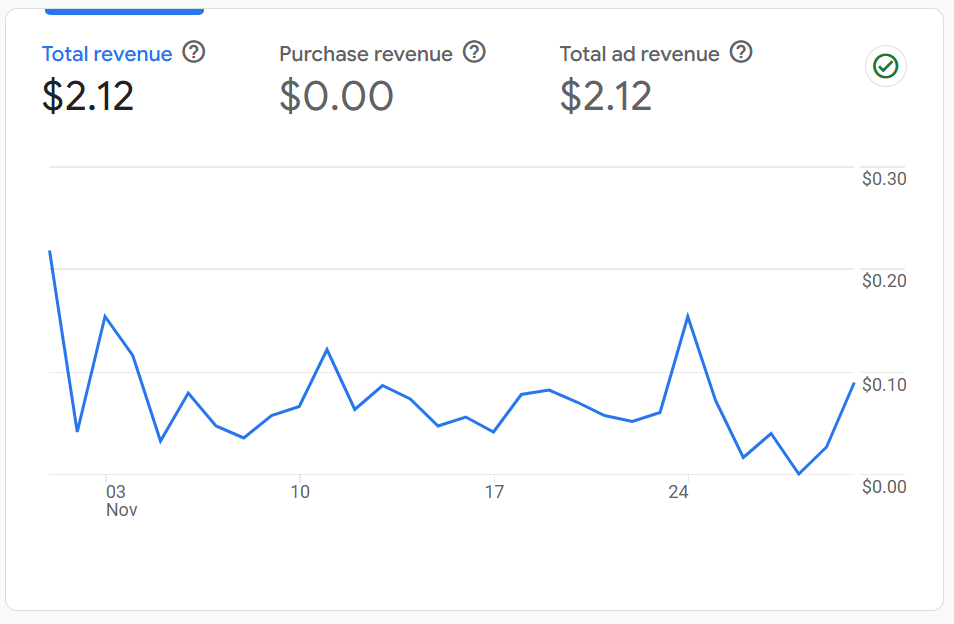
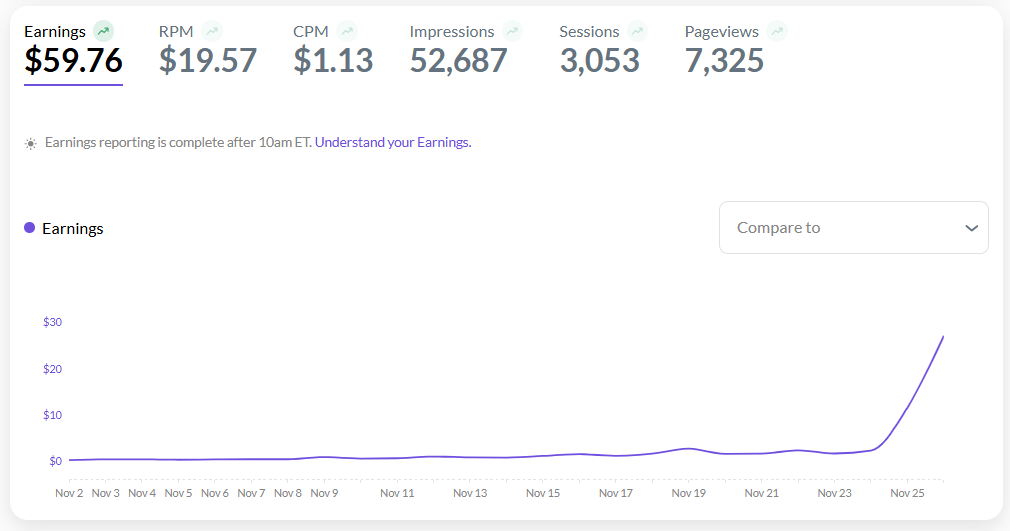
The Images above show my ad revenue comparison: November 2024 (dormant blog on AdSense) vs. November 2025 (actively worked blog on Journey by Mediavine). Traffic growth was gradual; improved monetization made existing traffic more valuable.
A Brief Spike (and Why It Doesn’t Change the Story)
There was also a short, unexpected moment where one post picked up traction over a couple of days.
That spike helped surface the impact of improved monetization (and taught me a thing or two about virality!)—but it wasn’t the reason growth held.
Revenue stayed higher afterward because the underlying systems (organic search, content structure, and ad efficiency) had already improved.
Moments happen. Systems decide whether they matter.
Two Kinds of Growth Happening at Once
Looking back, this four-month window included two parallel forms of growth:
Revenue growth (immediate):
- Higher RPMs
- Clear income signal
- Proof that the traffic already had value
Asset growth (long-term):
- Consistent publishing habits
- Improving SEO instincts
- Better internal structure
- Confidence that this was buildable
One answered “Can this make money?”
The other answered “Can this grow?”
Together, they changed how I viewed the blog entirely.
Why This Was a Big Deal (Even at Small Numbers)
On paper, going from $2 a month to $2 a day doesn’t sound life-changing.
But for me, it was huge.
For years, I’ve wanted to monetize something online—not as a fluke, but as a real, owned asset. Until this point, that goal was mostly theoretical.
Seeing nearly 3,000% growth wasn’t about the money. It was about proof. Proof that I could take something I built, figure it out as I went, and make it earn.
That shift—from “maybe someday” to “this works”—is what made this milestone feel legitimate.
What Didn’t Matter Much (Yet)
During this phase, several things had little measurable impact:
- Pinterest traffic
- Social media promotion
- Branding tweaks
- Publishing more than 1–2 posts per week
- Chasing traffic for its own sake
That doesn’t mean these never matter. They just weren’t the leverage points at this stage.
Where Things Stand Now
Today, the blog is:
- Earning modest but consistent ad revenue
- Built on a clearer SEO foundation
- Supported by sustainable publishing habits
- Poised for long-term, compounding growth
Just as importantly, I’m getting better every day—at writing, SEO, and understanding what actually matters.
The work now isn’t about proving this can work.
It’s about continuing to build it well.
Final Thoughts on Blog Growth in 4 Months
Most posts about blog growth in 4 months oversimplify what growth actually looks like.
This experience reinforced something far more realistic:
Early growth is about validation before scale.
Consistent posting proved long-term potential.
Organic search began behaving predictably.
Improved monetization made progress visible.
Together, they turned a dormant blog into a real, monetizable asset—and proved that building income online wasn’t just a dream, but something I’m already doing.





Get the Weekly Wellth Newsletter
Stay up to date & receive the latest posts in your inbox.