



The One Foldable Treadmill With Incline I’d Actually Recommend
If you’ve started hunting for the best foldable treadmill with incline, there’s a good chance your step count quietly collapsed the day your commute turned into a ten-second walk from the coffee maker to your desk.
Mine did. I run a business from a home office, and for a stretch there my “active” days were the ones where I remembered to let the dog out twice.
That’s the real problem a foldable incline treadmill is trying to solve — not fitness, exactly, but the slow erosion of baseline movement that happens when your whole day lives inside one room.
If you’re already leaning toward buying one, I’ll make this easy: I’ll tell you what actually matters in this category, which machine I’d point you to, and who should skip it.
This post contains affiliate links, meaning Reach Wellth may earn a commission if you buy through them, at no extra cost to you.
Why Movement Is Infrastructure, Not a Performance
The mistake most of us make with a work-from-home slump is treating it as a motivation problem. You tell yourself you’ll work out harder to make up for sitting all day, and then a deadline eats the workout, and the guilt compounds, and nothing changes.
Movement isn’t a performance you earn on good days. It’s infrastructure — the quiet floor of activity that keeps your energy, mood, and body functioning underneath everything else you’re trying to build.
When you work from home, that floor doesn’t get built by willpower. It gets built by lowering the activation energy so far that moving is easier than not moving.
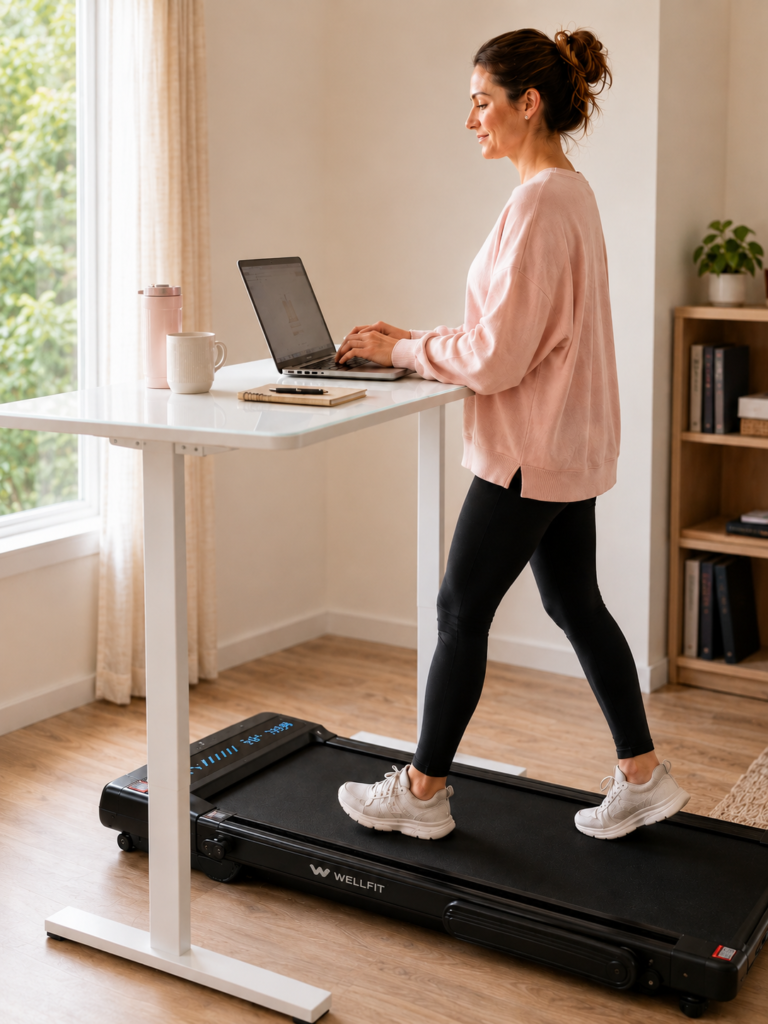
That’s the entire case for a foldable treadmill with incline: it puts the floor of movement inside the workday, at the exact desk where the problem started.
A machine that makes the system easier to run is worth real money. A machine that becomes a coat rack is not. Most of this post is about telling those two outcomes apart.
How I Vet Home Fitness Gear
I’m a certified health coach who’s spent the better part of two decades putting wellness and fitness equipment through its paces — barre and Pilates classes, cycling studios, personal training, home setups, guided apps, and more gear than I care to count.
I know what holds up, what quietly ends up in a closet, and which features are worth paying for versus which are marketing.
So when I evaluate a machine like this, I’m reading it on three things at once: the specs that actually predict daily use (fold height, noise, incline, motor, deck), how hundreds of real owners report it performing over time, and whether it fits the life of the person I’m recommending it to — someone building movement into a day that mostly happens at a desk.
Everything below runs through that filter. When something’s a genuine tradeoff, I’ll say so, including the cases where you should buy something else entirely.
What Makes a Foldable Incline Treadmill Different From a Walking Pad
This is the distinction that changes the whole buying decision, so it’s worth thirty seconds.
A walking pad is a flat, low-slung belt you shuffle along on at a slow pace while you work. Most top out around 3.7 mph, have no handrail, and no incline.
They’re genuinely good at one job: keeping you moving during meetings and emails. They’re also cheaper, and if that’s all you want, buy one and stop reading.
A foldable treadmill with incline is a different tool.
It still folds flat and tucks away, but it adds a raisable handrail, a real speed range that goes up into a run, and an automatic incline.
That combination means one machine covers two jobs most people otherwise split across a walking pad and a gym membership: the low-key movement during work, and the actual cardio workout.
In a small home, “one machine, two jobs” is not a nice-to-have. It’s the difference between owning this and owning nothing because you had no room.
What To Look For In a Foldable Treadmill With Incline
Here’s the checklist I’d hand a friend before they bought anything in this category. It doubles as the scorecard I used on the WELLFIT.
Footprint And Fold Height
The whole promise is that it disappears when you’re done. Check the folded height, not just the footprint — the ones that slide under a couch or bed fold to roughly 5 to 6 inches. If it only folds in half and still stands 2 feet tall, it lives in a corner forever, and corners are how good intentions die.
Speed Range
Decide honestly whether you want to run. If you’ll only ever walk during work, a slow belt is fine. If you want the option to do real cardio, you need a top speed up into the 7 to 9 mph range. Buying for the run you might do is only worth it if you’re honest that you’ll do it.
Incline
Incline is the feature people underestimate. At a desk-friendly slow speed, adding a grade meaningfully raises calorie burn and loads your glutes, hamstrings, and calves — so you get real work without having to sweat through a call at running speed. Automatic (motorized) incline matters here, because a grade you have to stop and adjust by hand is a grade you’ll never use.
Noise Level
If you take video calls, share walls, or have a napping kid in the house, the decibel rating is not a spec you can ignore. Anything rated under about 45 dB is quiet enough to walk during a meeting without broadcasting it.
Deck Size
A wider, longer belt feels safer and lets taller people run without clipping the edge. Around 17 inches wide and 44 inches long is a comfortable middle for both walking and a moderate run in a foldable frame.
Weight Capacity
Check the real number and give yourself a margin. A higher capacity usually also signals a sturdier frame and a beefier motor, which matters more for longevity than the marketing headline.
Controls And App
You want to change speed and incline without breaking stride — console buttons, a remote, or voice. An app is a nice bonus for tracking, but be wary of anything that hides core features behind a paid subscription.
Why the WELLFIT Is My Pick

The WELLFIT Auto Incline 4-in-1 Foldable Treadmill earns the recommendation because it hits every item on that checklist at once, and does it around $380 instead of the four-figure price a lot of incline treadmills carry.
It folds to 5.7 inches tall and rolls on wheels, so it genuinely stores under a bed, desk, or sofa. It runs from a 0.6 mph creep up to 8.6 mph, so it’s a walking pad during work and an actual treadmill when you want to push. The incline is automatic from 0 to 10%.
The 3.5 HP motor runs under 45 dB — quiet enough for calls — and holds up to 400 pounds. The belt is 44 by 17 inches with a 7-layer anti-slip surface and shock absorption built for your knees.
There’s a 5-level adjustable handrail (30.5 to 41 inches) so it fits different heights, an LED display for your stats, and control by console, remote, voice, or app with no subscription required.
It also ships fully assembled, which is a bigger deal than it sounds — “some assembly required” is another way good intentions die.
At the time I’m writing this it’s an Amazon’s Choice pick, rated 4.8 stars across 100-plus reviews, with 300-plus bought in the past month — and those owners consistently call out the same things I’d want from it: quiet enough to work next to, sturdy underfoot, and genuinely easy to fold and move.
As a first machine that covers both the walk-during-work job and the real-workout job in a home without a spare room, it’s the one I’d point you to.
What the Incline Actually Does For You
People ask whether 10% incline is “enough,” so here’s the plain version.
On a treadmill, incline is expressed as a percentage grade — a 10% incline means you climb 10 feet for every 100 feet you travel, which feels like a steady, noticeable hill. It’s not mountain-goat steep, but for walking and moderate running it’s the range that does real work.
The reason it matters for a work-from-home setup specifically: incline lets you get a genuine training effect at slow, meeting-friendly speeds.
You can walk at 2.5 mph on a grade and get your heart rate into a useful zone, load your lower body, and burn more than you would flat — all without the sweat and heavy breathing that make running-and-talking impossible.
That’s the sweet spot these machines are built for, and it’s exactly why the incline is the feature I’d refuse to give up.
Who It’s For, And Who Should Look Elsewhere
The most honest thing I can do is tell you when not to buy this.
It’s a Strong Fit If
You work from home or spend most of your day at a desk and your baseline movement has cratered.
You live in a house or apartment without a spare room for a full-size treadmill and need something that folds away.
You want one machine that handles both easy movement during work and a real cardio workout.
And you’re somewhere under a roughly $400 budget, where a comparable incline treadmill from a big-box fitness brand would run you two to four times as much.
Look Elsewhere If
You only ever want to walk slowly during meetings — a flat walking pad does that for less money, and there’s no reason to pay for a run you won’t take.
You’re a serious runner logging long, fast miles, in which case you want a full-size deck and a higher-horsepower motor, not a foldable frame.
You can’t comfortably move and set up an 80-pound machine on your own. (Make sure to grab a hand to help!)
Or you’re the kind of buyer who’s been burned before by equipment that became storage — in which case the honest fix isn’t a better treadmill, it’s a plan for where it lives and when you’ll step on it.
The machine only works if you do.
Are Foldable Treadmills Worth It?
Yes, with one condition: it’s worth it only if it lowers the bar to move on a normal, busy, unmotivated day. That’s the whole test.
The research on the underlying behavior is genuinely encouraging — walking while you work is linked to better focus and mood, real calorie burn over the course of a day, and less of the stiffness that comes from sitting for eight hours straight.
And a foldable incline model is the version most likely to actually get used in a real home, because it doesn’t demand a dedicated room and it covers more than one job.
The failure mode is equally real, and every honest review of this category names it: the treadmill that folds up beautifully and never gets unfolded.
Worth-it or not-worth-it comes down almost entirely to whether you’ll build a small, boring trigger around it — walk during your first meeting, walk while you read email, walk for the length of one podcast.
If you’ll do that, it pays for itself in energy alone. If you won’t, no machine on earth is worth it, and I’d rather you keep your money.
Where To Buy And What It Costs
The WELLFIT Auto Incline Treadmill is on Amazon for $379.99 at the time of writing, marked down from a $499.99 list price. It ships assembled from WELLFIT, with 30-day returns, so the risk of trying it is low.
If you’re building out a home movement setup more broadly, this pairs naturally with the way I think about fitting activity into an ordinary day — more on that in my piece on fitness as a third place and on how I actually use boutique fitness to stay consistent.
Frequently Asked Questions
Can You Actually Run On This Treadmill?
Yes. It goes up to 8.6 mph, which is a genuine run for most people, not just a fast walk. That’s what separates it from a standard walking pad, which usually tops out around 3.7 mph.
How Loud Is It For Video Calls?
The motor is rated to run under 45 decibels, which is quiet enough to walk during a meeting without your belt becoming the main character. Your footfalls at higher speeds will add some noise, so save the run for between calls.
Does It Really Fold Away Under a Desk?
It folds to about 5.7 inches tall and rolls on built-in wheels, so it can slide under a bed, desk, or sofa, or stand against a wall. That fold height is the reason it stays usable in a small space instead of becoming a permanent fixture.
How Much Weight Can It Hold?
Up to 400 pounds. That high capacity also tends to signal a sturdier frame overall, which matters for how the machine holds up over time.
Do You Have To Assemble It?
No. It ships fully assembled and ready to use out of the box, which removes one of the most common reasons home equipment sits unused.
Can You Use It Without the App?
Yes. You can control speed and incline from the console, a remote, or voice commands, and the LED display tracks your time, distance, speed, and calories on its own. The app is optional and doesn’t sit behind a subscription.
Is 10% Incline Enough?
For walking and moderate running at home, yes. A 10% grade is a steady, noticeable hill that meaningfully raises the effort and calorie burn at slow speeds — which is exactly the range that makes incline useful for a work-from-home routine.
The Bottom Line: Does It Lower the Bar To Move?
The best foldable treadmill with incline isn’t the one with the flashiest specs. It’s the one that’s still in use in month three, because it made moving easier than not moving on the days you didn’t feel like it.
The WELLFIT clears that bar: it folds away, it covers both the walk and the workout, the incline does real work at gentle speeds, and it costs a fraction of the incline treadmills you’d find at a big fitness brand.
If you’ve been feeling the quiet drift that comes from building a life at a desk, this is a genuinely good place to start rebuilding the floor.






Get the Weekly Wellth Newsletter
Stay up to date & receive the latest posts in your inbox.