



How to Fit Exercise Into a Busy Schedule – 6 Strategies That Actually Work
Learning how to fit exercise into a busy schedule feels impossible when you’re juggling work deadlines, family responsibilities, and the mental load of keeping everything running smoothly.
Trust me, I get it. As a single mom to a toddler running my own business, there are days when “workout” means chasing my little one around the living room or doing squats while brushing teeth at bedtime. And you know what? That counts.
You deserve better than the guilt cycle of promising yourself you’ll work out tomorrow, then feeling like you’ve failed when life inevitably gets in the way. You deserve practical strategies that actually fit into your real life—not some idealized version where you have an extra two hours every morning.
If you’re wondering how to fit exercise into a busy schedule without adding more stress to your already full plate, I’m here to tell you: it can be so much simpler than you think.
(And if you’re struggling with making health a priority at all, I wrote about how to prioritize your health when everything else feels urgent.)
Incorporating just one of these six strategies will help you fit exercise into a busy schedule in a way that feels sustainable, not overwhelming. Because improving your health shouldn’t require you to become someone you’re not.
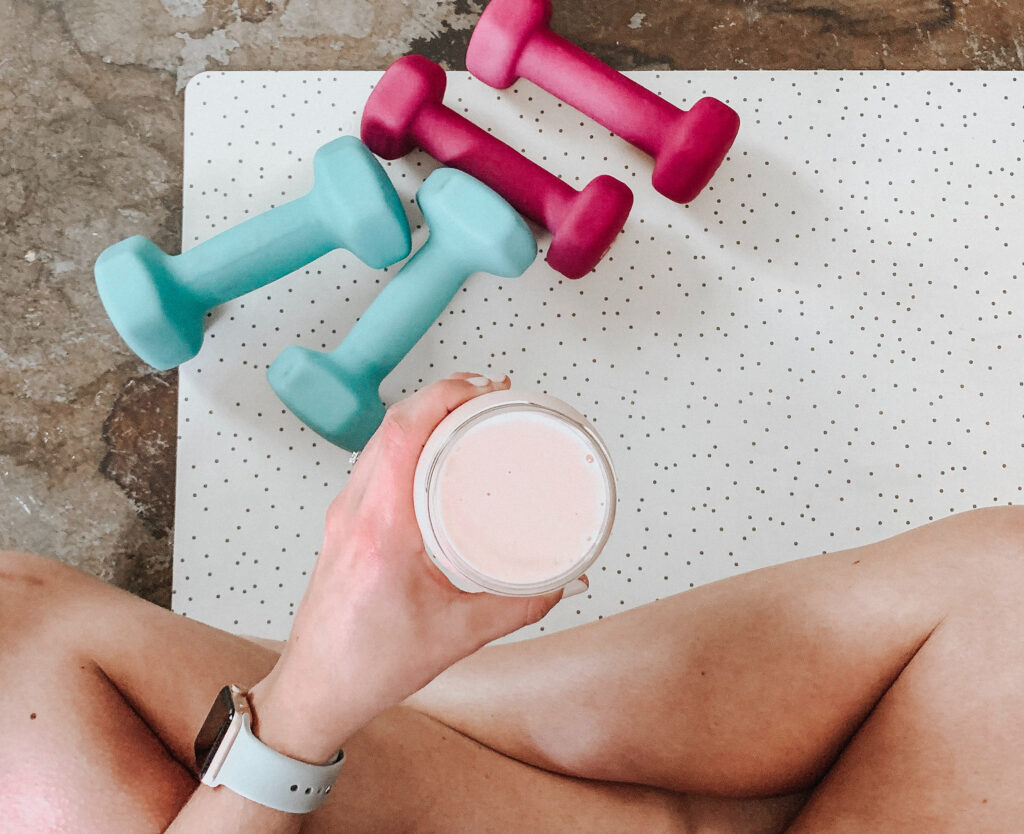
1. Reframe Your Mindset Around Working Out
This first one is huge—and it might be the most important shift you’ll make when figuring out how to fit exercise into a busy schedule. I’m talking about your mindset.
What do you think of when you tell yourself that you need to work out?
Do you imagine going to a gym, spending hours lifting weights, or going on long runs?
Do you see yourself spending tons of money and time on expensive classes after work?
Are you picturing yourself doing something you absolutely hate because you feel like that’s what you “should” be doing?
If so, no wonder fitting in a workout when you’re already stretched thin feels impossible.
Here’s the truth: How you think about fitness and working out can move you closer or further away from achieving your health goals.
Movement As Exercise
What if instead, you saw working out as simply moving?
This one reframe changed everything for me. Once I stopped thinking I needed to do a “proper workout” and instead focused on just moving my body, suddenly opportunities were everywhere.
Dancing in the kitchen while making dinner? That’s movement. Taking the stairs instead of the elevator? Movement. Playing tag with your kids at the park? Absolutely movement.
Could reframing what you traditionally think of as a workout to getting yourself to move instead help you see fitness in a new light that is less overwhelming and time-consuming?
Thinking of your workouts as movement opens doors to all kinds of ways we can move our bodies throughout the day—ways that actually fit into your life instead of requiring you to create an entirely separate life around fitness.
This mindset shift is foundational. And it naturally leads us to…
2. Make Working Out Fun (Or At Least Not Miserable)
My guess is that if you’re reading this, you’re a full-time professional, maybe a parent, and your daily responsibilities are already overwhelming.
Being a working mom myself, I know for a fact that our to-do lists are not always fun. There are parts of our day we have to power through to get to the good stuff.
So why should something we have complete control over—our movement and fitness—feel like another chore?
Working out is for YOU and your health.
This is your chance to do something you actually enjoy, not something you think you “should” do because it burns the most calories or some fitness influencer swears by it.
Here’s what actually matters: It’s proven that the more you like something, the more likely you’ll stick to it.
Find Your Joy in Movement
Were you an athlete growing up? Look for recreational sports leagues—soccer, kickball, volleyball. Many cities have adult leagues that are more about fun and community than competition.
Love to stretch and breathe? Barre, Pilates, and yoga classes offer that mind-body connection that can feel meditative (and trust me, busy moms need that mental reset as much as the physical movement). I’ve done over 150 barre3 classes and they’ve been game-changing for both my strength and stress levels. If yoga is more your speed, reconnecting with yourself through yoga can be incredibly powerful.
Miss dancing around your room as a teenager? Put on your favorite playlist and dance for 10 minutes. No choreography required. Just move. (And yes, I genuinely own a Dance with Julianne: Cardio Ballroom DVD that I unironically love.)
You can easily search for hundreds of workouts on YouTube—everything from 10-minute HIIT sessions to gentle stretching routines you can do before bed.
The key is figuring out what you actually like, then giving yourself permission to do that instead of forcing yourself into workout formats that make you miserable.
Because here’s the thing: If you hate running, you’re never going to consistently run. (Though if you love spin classes, you might want to check out my CycleBar review—it’s one of my favorite ways to get cardio without feeling like I’m suffering.) Find what brings you joy (or at least doesn’t fill you with dread), and that becomes your thing.
3. Build the Habit by Making It Ridiculously Easy
You already have enough on your plate, so let’s not complicate things.
If you follow the strategy of making your workouts fun, fitting them in becomes exponentially easier. But learning how to fit exercise into a busy schedule long-term? That requires building an actual habit.
Generally, research shows it takes about 66 days to build a habit. Yes, building a habit is tough and takes momentum—especially when you’re already exhausted. But here’s the good news: once you’ve crossed that threshold and the behavior becomes automatic, the outcome is ten-fold.
Forming a habit means you don’t have to expend precious mental energy deciding whether to work out or negotiating with yourself every single day. It just becomes what you do.
Start Small and Stack Your Habits
Small actions make all the difference:
- Lay out your workout clothes the night before (or sleep in them if you’re a morning exerciser)
- Put your workout on your calendar like any other appointment
- Set out your yoga mat in a place where you’ll trip over it
- Queue up your workout playlist so it’s ready to go
These tiny acts of preparation remove friction and make it more likely you’ll follow through.
But the number one way to build the habit of working out is to establish a consistent routine.
Find an activity that you enjoy, then do it on the same day and at the same time each week until it’s fully woven into your regular schedule. Your body and brain will start to expect it.
If you want to see exactly how I fit exercise into my busy schedule, check out my single mom workout routine—and learn how to build a workout routine that works for you.
Why Morning Workouts Work Best for Busy Schedules
I know, I know—waking up earlier when you’re already exhausted sounds terrible. But hear me out.
There’s a good reason many experts recommend working out in the morning, especially for busy parents and professionals.
By working out first thing, you eliminate the million ways exercise gets bumped off your to-do list later in the day.
No meetings running late, no surprise meltdowns at pickup time, no “I’m just too tired” at 8 PM when the kids are finally in bed.
Plus, the boost in endorphins and energy you get post-workout will actually help you focus and be more productive during the rest of your day. You’ll show up as a better version of yourself—for your work, for your family, for you.
And if mornings truly don’t work? That’s okay too. The best time to work out is whenever you’ll actually do it.
4. Hold Yourself Accountable (Because Willpower Isn’t Enough)
Building new habits is hard, especially when you’re already managing a demanding schedule. One of the most effective ways to stick with working out is to create accountability structures that work for you.
Find a group of friends to join you, or a workout buddy who’s also trying to figure out how to fit exercise into a busy schedule. When someone else is counting on you to show up, you’re far more likely to follow through—even on days when your motivation is at zero.
Or sign up for a paid class. Whether it’s a studio membership, a virtual program, or a group fitness class, putting money down creates commitment. Make friends with the instructors and other regulars. That sense of community and support can be the difference between showing up and staying home.
The Luxury of a Personal Trainer
Still struggling? Hire a personal trainer if it’s financially feasible.
I know this feels like a splurge, and it can be costly. But it might also be the most effective investment in your health you can make.
I wrote a whole deep dive on whether a personal trainer is worth it—spoiler alert: for me, absolutely yes.
Here’s why: You’ll not only be on the hook for showing up (and nobody wants to waste money by skipping), but you’ll also have more efficient, effective workouts with better results.
As a busy professional and mom, I cannot tell you how luxurious it is to have a trainer. You already make hundreds of decisions every single day—what to make for dinner, how to handle a work crisis, which battles to pick with your toddler.
With a trainer, there are zero decisions about your workout. No figuring out which exercises to do, what equipment to use, or whether you’re doing it right. All you have to do is show up. That’s it.
At a minimum, I work out for 30 minutes twice a week with a personal trainer. By doing so, I guarantee myself that no matter how chaotic life gets, I will have completed at least two solid workouts for the week.
Investing financially and socially will help you keep your commitment regardless of your schedule. And the benefits of exercise—the endorphins, the strength, the mental clarity—will remind you why you’re worth taking the time for your workouts and your health long-term.
5. Set a Fitness Goal That Motivates (Not Intimidates) You
One incredibly effective strategy I’ve found for staying consistent is having a specific fitness goal to work toward.
Notice I didn’t say a weight loss goal or a “look like this” goal. I’m talking about a performance goal—something that challenges your body’s capabilities rather than just its appearance.
As someone who played sports growing up, I love activities that give me something to train for. These days, my competitive sports days are behind me, but that doesn’t mean I can’t still challenge myself.
My Century Ride Story
For the last few years, I’ve focused on cycling. Through a non-profit fundraiser to raise money for cancer research, I set a goal to ride 100 miles in a single day—a century ride.
That goal instilled enough healthy fear to get me off the couch and onto a bike or into a spin class regularly. Not paralyzing fear, but enough to make me take my training seriously. Because I knew that if I didn’t prepare, there was no way I’d finish that ride.
Want to read the full story? Check out my first 100-mile bike ride experience—spoiler: I survived!
The point is to find a goal that challenges you enough to inspire consistent action—not something so big it overwhelms you into paralysis.
With only so much time in the day (especially as a parent), focusing on one specific sport or goal that requires you to improve your fitness gives you clear direction.
How to Choose Your Goal
Ask yourself: What would make me feel genuinely proud of my body’s capabilities?
- Running a 5K without stopping?
- Doing one full pull-up?
- Holding a plank for two minutes?
- Completing a hiking trail you’ve always wanted to try?
- Keeping up with your kids at the playground without getting winded?
- Starting a strength training routine? (Here are 7 reasons to lift weights that go way beyond aesthetics.)
Then visualize what you’ll be capable of doing once you stick with it long enough to achieve it. Who is the person you see at the end of that goal?
Once you’ve set your goal and have a clear vision of the outcome you want, determine what steps and actions you can take to accomplish it. Is it running 20 minutes three times a week? A combination of strength workouts and yoga to build the foundation?
From there, it’s all about sticking to those actions and making small improvements, one by one, until you reach your fitness goal.
Having this purpose gives you concrete reasons to incorporate workouts into your daily schedule. And each workout you complete toward that goal will give you greater confidence and momentum.
6. Just Do Something (Seriously, Anything Counts)
Finally, and I cannot stress this enough: when all else fails, remember that something is always better than nothing.
This is especially important for perfectionists (I see you). We often fall into the trap of thinking that if we can’t do the “full” workout, there’s no point in doing anything at all.
That’s a lie that keeps us stuck.
Micro-Movements Add Up
When you’ve had a hectic week and life has completely derailed your fitness plans, it’s absolutely OK to do whatever movement you can squeeze in.
Quick ways to fit exercise into a busy schedule, even on your most chaotic days:
If you notice yourself getting sleepy after lunch around 2 PM, instead of reaching for another coffee and powering through, try a ten-minute walk around your building. Or do a five-minute jog. Or bang out 100 jumping jacks at your desk. (Your coworkers might think you’re odd, but you’ll feel amazing.)
When you have a lull for even just five minutes—while dinner is in the oven, during a conference call where you’re not speaking, while your kids are occupied with a show—do something spontaneous. Drop to the floor for ten pushups. Do squats while you wait for your coffee to brew. Stretch while you’re on hold with customer service.
Had a terrible, exhausting day? Turn on your favorite music the moment you get home and dance for 10 minutes. Just move your body. Let it shake off the stress.
Walking your dog? Use that time to do some high knees or jog for part of the route. Turn a daily obligation into a movement opportunity.
Life is full of competing demands—work deadlines, kids’ needs, household tasks, relationship maintenance, and about a thousand other things requiring your time and attention.
But your health is not optional. It’s the foundation that allows you to show up for everything and everyone else.
You deserve happiness and a great quality of life. Fitness and movement are key parts of maintaining that foundation—not as punishment for your body, but as an investment in your ability to live fully.
The Bottom Line: You Already Have What You Need
As the adage goes, we all have 24 hours in the day. And yes, some people’s 24 hours include way more privilege, support, and flexibility than others. I see you if you’re doing this solo, if you have a demanding job, if you’re managing health issues, if you’re parenting on top of everything else.
But here’s what I know: Using just two and a quarter hours toward the minimum recommended three 45-minute workouts per week will never be wasted time. That’s less than 10% of your week to invest in the body and mind that carry you through everything else.
Now you know exactly how to fit exercise into a busy schedule—even when it feels impossible, even when you’re exhausted, even when you think you don’t have time.
You don’t need to implement all six strategies at once.
Pick the one that resonates most with where you are right now. Start there. Build from there.
Maybe it’s the mindset shift that movement counts as exercise. Maybe it’s finding one fun activity and committing to it twice a week. Maybe it’s just doing ten squats while you brush your teeth tonight.
Whatever it is, start. Because you’re worth it. Your health is worth it. And you’re doing better than you think you are.
You got this, friend.






Get the Weekly Wellth Newsletter
Stay up to date & receive the latest posts in your inbox.